

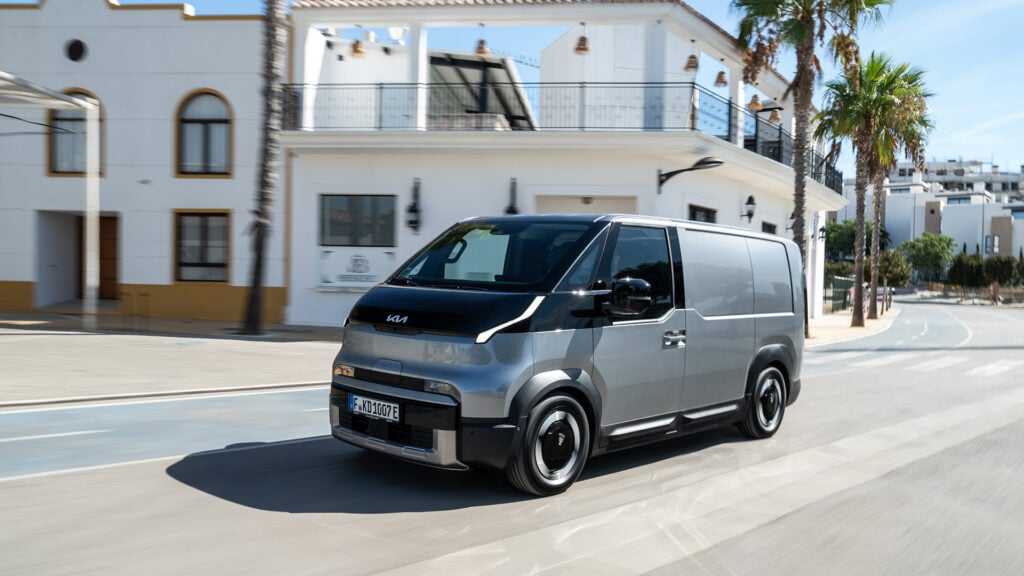
The Kia PV5 came to the UK in 2025 and has since won International Van of the Year, What Van? Van of the Year and Parkers Van of the Year for 2026. We’ve measured it, built on it and quoted it for customers, and we think it’s one of the best electric vans you can turn into a camper. Whether it’s right for you depends on how you’ll use it, so here’s what we’ve found.
In short: the Kia PV5 is a new electric van, built electric from the ground up, with up to 243 miles of official range, a seven-year Kia warranty and a socket (V2L) that runs an induction hob straight from the main battery. We convert the PV5 Cargo Plus Long Range in two layouts, the Mandalay and the Chamonix, and a four-berth camper with a pop-top costs from £59,895 all in. It suits people who want a new electric camper with plenty of room inside. It doesn’t suit anyone after a second-hand bargain or gas heating.
What is the Kia PV5, and why convert it into a campervan?
The PV5 was designed as an electric van from the start, on Kia’s E-GMP.S platform, rather than being a diesel van with a battery added later. You can see it when you open the side door. The floor is low and flat, and there’s no engine-shaped lump to build around.
Inside, the loadspace is 2,255mm long, 1,520mm tall and 1,565mm wide at its widest, with 1,310mm between the wheel arches. That’s room for a full double bed, a proper kitchen and storage. Add a pop-top and you can stand up, and two more people can sleep in the roof.
Kia PV5 campervan range and charging
The Long Range model has a 71.2kWh battery and an official range of up to 243 miles on the 2027 model. Once it’s a camper, with furniture and kit on board, you’ll get less than that, depending on how fast you drive, the weather and the hills.
On a rapid charger it takes up to 150kW, so 10 to 80% takes about half an hour. At home a normal wallbox will fill it overnight, and it can take up to 11kW if you have a three-phase supply.
V2L: the van is your hook-up
The thing that really changes how the PV5 works as a camper is Vehicle-to-Load, or V2L. On the Plus trim there’s a socket that gives you up to 3.6kW straight from the main battery. That’s enough to run an induction hob, a kettle or a heater.
So we build the electrics around it. A lithium leisure battery looks after the everyday things like the lights, fridge, water pump and USB charging, and it tops itself up while you drive. Cooking and the 240V sockets run from the main battery through V2L. That means you don’t need a big inverter and a second bank of batteries, which saves money and weight. You can still plug into hook-up at a campsite like any other camper.
There’s no gas or diesel anywhere in the van. You drive, cook and keep warm on electricity.
Which PV5 to order
If you’re ordering a PV5 to convert, there’s really only one version to get: the PV5 Cargo Plus Long Range.
- Plus, not Essential. Plus has V2L, which our electrics are designed around. Essential doesn’t.
- Long Range, not Standard Range. 71.2kWh and up to 243 miles WLTP, against up to 177 miles from the 51.5kWh Standard Range. The heat pump is only offered on Long Range.
- Cargo, not Passenger. The Cargo is the panel van we strip, insulate and line. The Passenger has too much factory interior to convert properly.
Two things have to go on the Kia order because you can’t add them later. The first is the heat pump (£780), which we’d recommend to anyone who’ll camp outside the summer. The second is the paint colour, if you don’t want white (around £750).
Two layouts
We offer both our layouts on the PV5, and both start at £20,399.
The Mandalay has a Smart Beds rock and roll bed on rails. By day it’s a forward-facing back seat with two three-point seatbelts, so you have four belted seats including the front. At night it folds down into a double. It’s the one for families, or anyone who sometimes needs to take passengers.
The Chamonix has a side bench in the day and a pull-out slat bed at night, 1,700mm long and 1,050mm wide, extending to 2,000mm. There are no seatbelts in the back, but you get much more open space. Couples and people travelling on their own tend to choose it. We build the bench and bed unit from birch ply in our workshop and fit it to the van, so it doesn’t rattle.
Add a pop-top with a roof bed and either layout sleeps four.
What’s in every build
Before anything goes in, we take out the factory trim, fit a vapour barrier and fill the panels with Thermafleece sheep’s wool. Then a breathable carpet lining goes on and the vinyl flooring goes down.
The furniture is FSC birch ply with no plastic edging, and the worktop is solid wood. The kitchen has a stainless steel sink with an electric pump, a compressor fridge and a double induction hob. You also get blackout curtains, upholstery in the fabric you choose, LED lighting and USB, USB-C and 240V sockets. You pick all the finishes, and none of them cost extra.
Heating
The heat pump warms the cab using the main battery, and it works when you’re parked too. If you want heat in the back where you sleep, we can fit a Truma electric heater (£1,200) with its own ducting and thermostat. It runs from hook-up or from V2L, and on a cold night on a low setting it uses about ten miles of range.
What it costs
All prices include VAT. Vehicle prices are set by Kia and can change.
| PV5 Cargo Plus Long Range, after the £5,000 Plug-in Van Grant | £34,416 |
| Heat pump (Kia order) | £780 |
| Conversion, Mandalay or Chamonix | £20,399 |
| Drivelodge pop-top (£3,200) and roof bed (£400) | £3,600 |
| Two fixed windows | £700 |
| 4-berth, all in | from £59,895 |
You pay Kia for the van and us for the conversion. We don’t charge for finding the van, and the quote lists the pop-top and every extra separately before you commit. For that you get a brand-new van with Kia’s seven-year, 100,000-mile warranty and eight years on the battery, for about the same money as a converted second-hand ID. Buzz.
Kia PV5 or VW ID Buzz?
Both make very good electric campers. The Buzz has a bigger battery (79kWh), a bit more range (up to 276 miles), faster charging and more width at its widest point, and you can buy one second-hand. The PV5 has more room between the wheel arches, V2L built in and a longer warranty, and it’s cheaper new. There’s no second-hand PV5 market yet, so for now you’d be buying new.
Who should choose a Kia PV5 campervan?
The PV5 makes most sense if you:
- want a brand-new electric camper rather than a used one
- value space inside: the flat floor, the room between the wheel arches and lots of headroom
- like the idea of cooking and running a heater from the van’s own battery through V2L
- want a long warranty: seven years on the van and eight on the battery
It makes less sense if you want a second-hand bargain, gas heating, more than four seatbelts, or the most range per charge, where the ID. Buzz goes further.
Kia PV5 campervan conversion or a flat-pack camper kit?
You may have seen the flat-pack camper kit made for the PV5 Passenger by Vanlab, in partnership with Kia. It’s a removable kit you put together yourself, with a bed, a table and seating, and it suits occasional camping in a van you mainly use for other things.
A Sunbox conversion is a different thing. We start with the PV5 Cargo, take out the factory trim, insulate the panels with sheep’s wool and line the van, then build a kitchen, bed and storage in birch ply to fit it. You get proper electrics, water, cooking and a pop-top if you want one. A kit is camping gear that goes in a van. A conversion turns the van into a camper.
Kia PV5 campervan FAQs
How far will a Kia PV5 campervan go on a charge?
Kia’s official figure for the 2027 Long Range model is up to 243 miles. In a loaded camper you’ll get less, depending on speed, temperature and terrain.
Can I cook without a campsite hook-up?
Yes. The induction hob runs from the van’s drive battery through Vehicle-to-Load, so you can cook a full meal anywhere.
What is V2L on the Kia PV5?
Vehicle-to-Load is a socket on the PV5 Plus that gives up to 3.6kW from the main battery. In a camper it runs the induction hob, a kettle or a heater, so the van works like a campsite hook-up you carry with you.
Is a Kia PV5 campervan cheaper than an ID. Buzz?
On a new van, yes. A four-berth PV5 camper from us is from £59,895, including a brand-new van after the grant. A four-berth Buzz on a new van is nearer £68,000. A converted second-hand Buzz costs about the same as a new PV5 camper.
What’s the difference between a Sunbox PV5 and a PV5 camper kit?
A kit is removable furniture you fit yourself, for occasional camping. A Sunbox PV5 is a full conversion: insulated and lined, with hand-built furniture, a kitchen, electrics designed around V2L, and a pop-top if you want one.
How many people does it sleep?
Two in the main bed. Add a pop-top with a roof bed and it sleeps four. The Mandalay has four belted seats; the Chamonix has two.
Can you convert the PV5 Passenger?
No. We convert the PV5 Cargo, which we strip, insulate and line properly. The Passenger has too much factory interior to do that well.
Can I add the heat pump later?
No. The heat pump and any premium paint colour have to be specified on the Kia order. Neither can be fitted afterwards.
Can you adapt the design for my needs?
Usually, yes. Our layouts have been refined over a lot of builds, and we’re happy to change them. Customers have asked us for grab rails, bike tethering points, roof bars and space for their dog, and we routinely adapt our designs for accessibility. Tell us what you need and we’ll see what we can do.
Is there gas on board?
No. Everything in a Sunbox PV5 runs on electricity, including the cooking and heating.
Do you find the van for me?
We can order a new PV5 through a Kia dealer in your spec. You pay Kia for the van and us for the conversion, with no sourcing fee.
How long does the conversion take?
Usually three to six weeks in our Newhaven workshop once the van arrives, depending on the spec.
So is it the best electric camper in the UK?
If you want a new electric camper with a long warranty and a van that can run your cooking, the PV5 is very hard to beat for the money. If you’re after a second-hand bargain or gas heating, it’s not the van for you. Either way, we’re happy to talk it through.
We build every PV5 by hand at our workshop in Newhaven, East Sussex. It usually takes three to six weeks, depending on the spec. Our work has a five-year warranty, and you’re welcome to come and see vans being built and meet the people who’d build yours. Call 01273 117471, email hello@sunboxcampers.co.uk, or download our free Electric Campervan Guide.
Related reading: Kia PV5 conversion page · Mandalay on the Kia PV5 · Chamonix on the Kia PV5 · Kia PV5 campervans in the UK: your options and what to ask · The 4 best electric vans for campervan conversion · Fiat e-Scudo vs VW ID Buzz · The ultimate guide to heating your electric campervan