

Which Electric Van Should You Choose?
If you’re reading this, you’re probably asking: is now the time to go electric?
We’ve been converting electric campervans for years, and the honest answer is: it depends. Electric campervans are genuinely viable now, but they’re not right for everyone, and the three main options suit very different people.
This guide cuts through the marketing to give you the real picture: actual range figures (not optimistic manufacturer claims), genuine limitations, and honest guidance on which van suits which lifestyle. We convert all three of these vehicles, plus others, so we have no reason to push you toward one over another. We’d rather you choose correctly.
The Three Contenders
At Sunbox Campers we’ve converted many electric vans, and it’s these three that stand out time and time again as the absolute best electric vans for conversion.
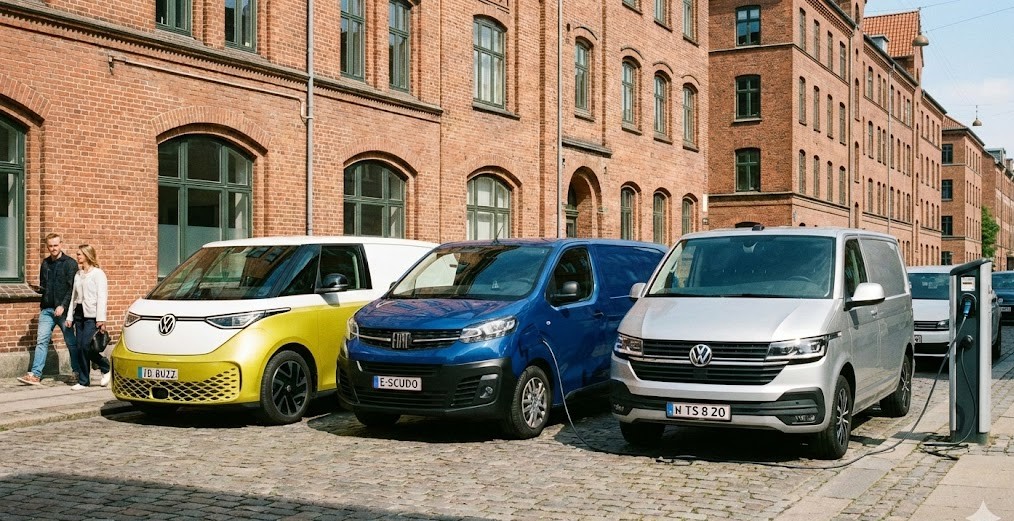
Fiat e-Scudo (and Stellantis siblings: Citroën ë-Dispatch, Peugeot e-Expert, Vauxhall Vivaro Electric)
A proven commercial van platform with full traditional campervan capability: off-grid heating, pop-top roof, rock ‘n’ roll bed, 4-berth. In the case of the Fiat e-Scudo nothing is lost by going electric.
VW ID Buzz
The icon. That styling, that heritage, that feeling. Better range, faster charging, and something that goes beyond specifications.
VW e-Transporter / Ford E-Transit Custom
The Transporter name with an electric drivetrain. Same full campervan capability as the e-Scudo: off-grid heating, pop-top roof, rock ‘n’ roll bed, 4-berth. Familiar layout.
Let’s look at each of these vans and compare them honestly.
Fiat e-Scudo Campervan: Five Badges, One Excellent Van
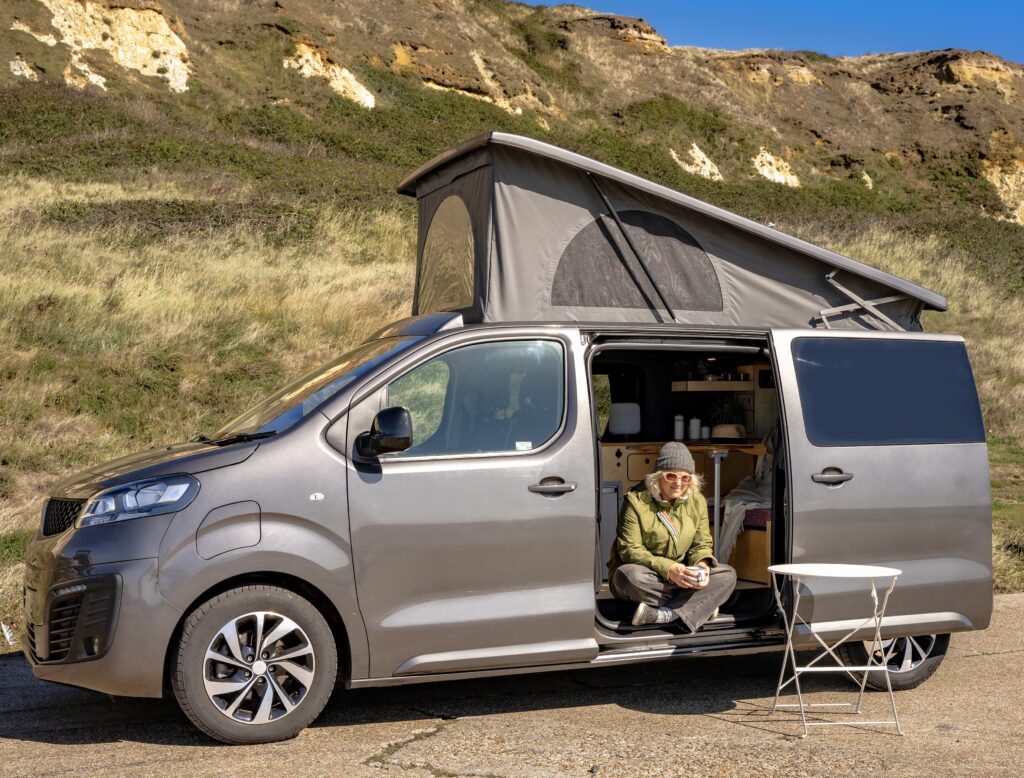
The e-Scudo flies under the radar. Most people searching for electric campervans have heard of the ID Buzz; fewer know this option exists. What’s exciting is that this van (in our opinion) is one of the best electric vans for conversion you’ll find on the market today.
What You’re Getting
The e-Scudo uses Stellantis’s proven electric van platform, shared across five badges. This means strong parts availability and extensive real-world testing across thousands of commercial vehicles. The fact that these vans have been around for a while now means that there is a healthy second-hand market.
- Battery: 75kWh (68kWh useable)
- Official range: 205-219 miles (WLTP)
- Real-world range: 170-180 miles in mixed driving
- Cold weather/fully loaded: 140-160 miles
- Rapid charging: 0-80% in approximately 45 minutes at 100kW
The range figures deserve honesty. You won’t get 205 miles in the real world—not with a converted campervan carrying passengers and gear. Plan for 170 or 180 miles in good conditions, less in winter or on motorways. But charging is quick and easy.
The Heating Advantage
Unlike the ID Buzz, we can install off-grid heating in the e-Scudo.
The chassis allows us to safely fit a Propex gas heater which runs from a campingaz canister, giving you reliable warmth without draining your leisure battery. This is the difference between “can wild camp in Scotland in February” and “needs to plan around campsites with hook-up for an electric heater in winter.”
If year-round, all-weather camping matters to you, this is a big deal. More on why heating is so important in the dedicated section below.
Cooking in the E-Scudo
The E-Scudo offers a range of cooking options including a fully electric induction hob set-up through to a more traditional gas hob set-up. Whilst the electric induction hob offers completely fossil-fuel free cooking (as the induction hob can be powered via your solar panel), it is more expensive as it requires a lithium battery and a large inverter in order to power the hob. As it is reliant on your leisure battery to power it, it is also a bit less reliable, because there are some circumstances where you are off-grid, your battery might be quite low in charge, and you wouldn’t then ideally want to drain it further by using the induction hob. This kind of situation is more likely to occur in the winter, but it does bear consideration. For the low-down on heating your electric van read our detailed guide: How to heat your EV camper.
A gas hob fuelled by a Campingaz bottle offers more off-grid security especially in the winter, as you wouldn’t be relying on your leisure battery to power your hob.
A hybrid option could be to have a gas hob with an induction hob in a drawer to plug in when you have external hook-up. Or, the induction hob with lithium battery / inverter set-up, with a good old fashioned gas camping cooker as back-up.
Interior Space and Family Capability
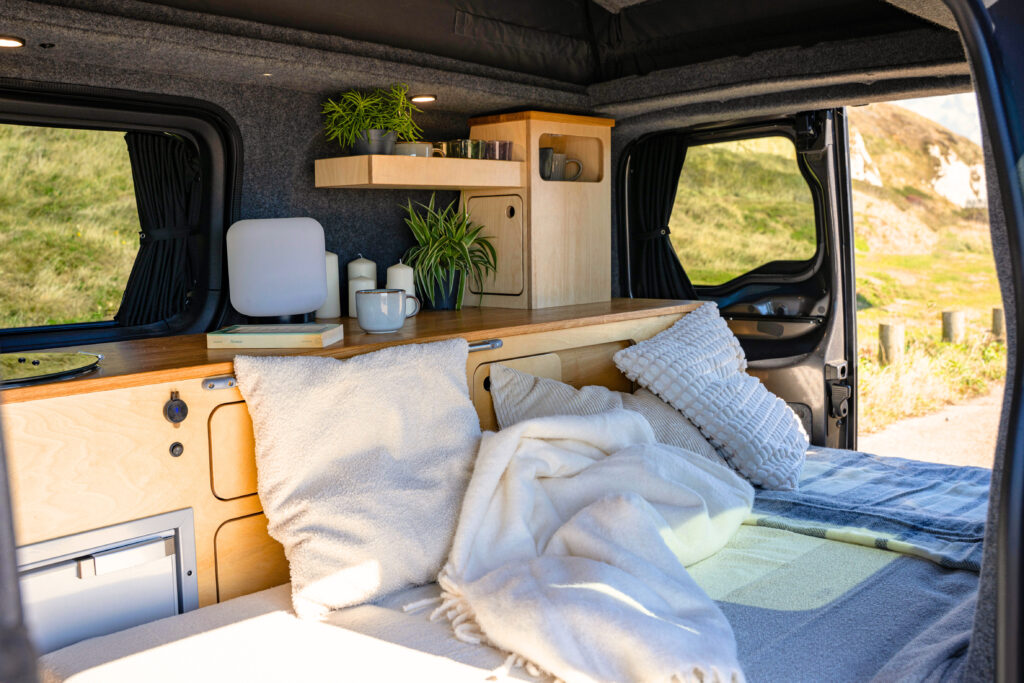
The e-Scudo offers a load width of 1,628mm—nearly 400mm wider than the ID Buzz. In practical terms, this means you can have a roomy double bed (in campervan terms) for two adults.
It also means we can create a genuine 4-berth campervan with a pop-top roof: two adults in the rock ‘n’ roll bed downstairs (which converts to belted seats for travel), two more in the roof. It also means we can have four to five belted travelling seats, with two or three in the front and two in the rear. For some people, this may be the deciding factor.
The Stellantis Advantage
The e-Scudo is mechanically identical to the Citroën ë-Dispatch, Peugeot e-Expert, Vauxhall Vivaro Electric, and Toyota Proace Electric. If you find a good example of any of these, we can convert it. This dramatically expands your options when sourcing a base vehicle.
We can also source a van for you if you want as we have a partnership with a Fiat dealer.
The e-Scudo is Right For You If:
- You want year-round camping capability, including off-grid in winter
- You’re travelling as a family or with friends and need 4 berths
- You want a small camper with the widest possible interior space for sleeping and living
- Off-grid heating that works anywhere matters to you
The e-Scudo is NOT Right For You If:
- Maximum range per charge is your priority
- The ID Buzz styling genuinely speaks to you—that matters too
VW ID Buzz Campervan: The One That Makes You Smile
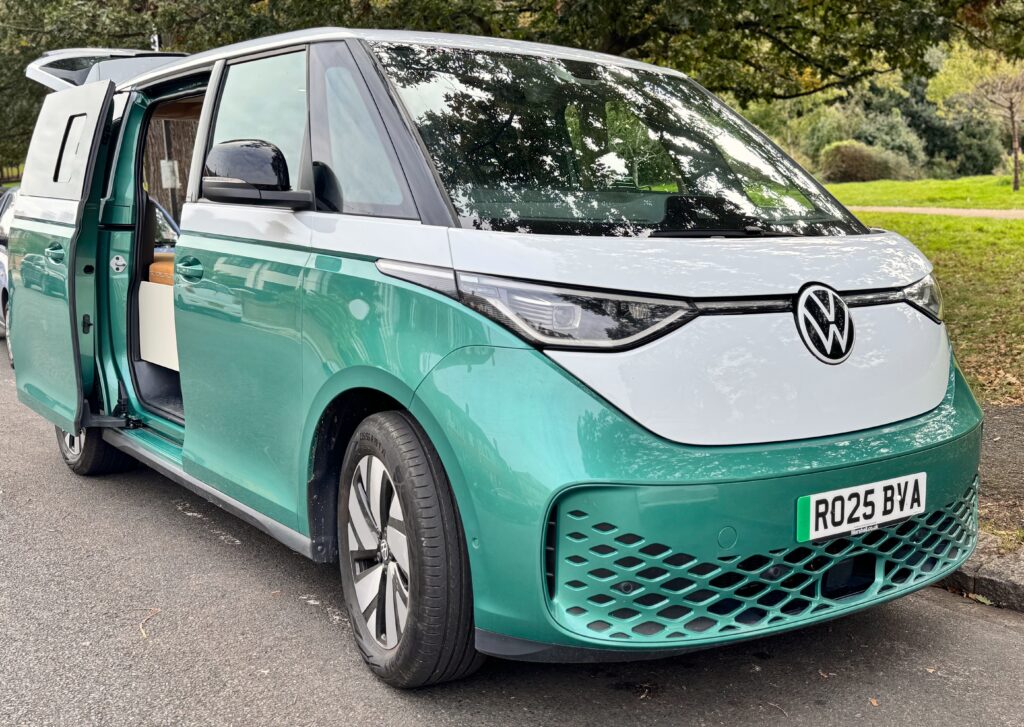
The ID Buzz costs more than the e-Scudo. It can’t have off-grid heating installed. The interior is narrower. The cooking is restricted to one induction hob.
And people queue up to buy them.
There’s something about this van that doesn’t fit neatly into a specifications comparison. It taps into decades of VW campervan heritage, wrapping modern electric technology in design-led styling that makes people smile—both the people driving it and everyone who sees it. There is something about the simplicity of the Buzz Camper that means its limitations become its strength.
What You’re Getting
- Battery: 86kWh (77-85kWh useable depending on variant)
- Official range: 234-291 miles (WLTP, varies by model)
- Real-world range: 180-230 miles depending on conditions and driving style
- Cold weather/motorway: 150-190 miles
- Rapid charging: 10-80% in approximately 26-33 minutes at up to 200kW
The ID Buzz genuinely offers a better range than the e-Scudo, and it charges faster. Independent testing has shown 228 miles at a steady 70mph, and around 180-190 miles in mixed real-world driving. In cold weather, expect that to drop—some owners report as low as 150 miles when temperatures fall and the heating’s working hard.
The Simplicity
The Buzz doesn’t try to do everything. When you’re cold, you run the vehicle’s heating or plug into a campsite hook-up. When it’s properly cold and you’re off-grid, you use quality bedding and 12V electric blankets.
Buzz owners tell us they stopped trying to optimise for every scenario and just started enjoying trips more. They plan around three-season camping, use campsites when it’s cold so they can have hook-up to power their heating, or enjoy the challenge of a cold night off-grid. Or use the Buzz when it comes into its own in the summer months, and for hybrid road trips where they stay in campsites some of the time and at other times stay in hotels.
Interior Considerations
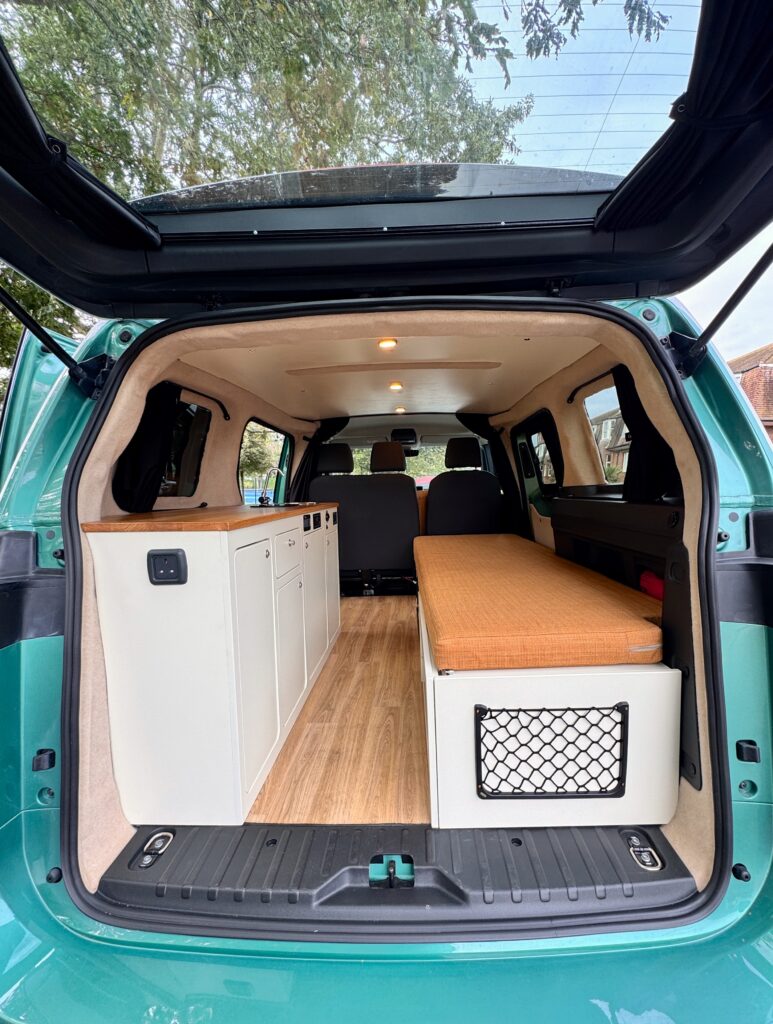
The Buzz is narrower inside than the e-Scudo—1,230mm load width versus 1,628mm. Two adults sleep comfortably downstairs; with a pop-top roof you can sleep four, though it’s tighter than the e-Scudo.
For our Buzz conversions, we work with sustainable materials like bamboo and focus on making the most of the available space. Induction cooking keeps things purely electric and mostly powered by solar.
Heating in a VW ID Buzz
We cannot install off-grid heating in the ID Buzz—the chassis design doesn’t permit it. This is a genuine constraint, not something that can be worked around.
VW ID Buzz owners use a combination approach:
- The vehicle’s built-in heating system for warming the space (uses traction battery, so be mindful of charge level)
- Campsite hook-up for electric heating when available
- 12V electric blankets for sleeping (these draw minimal power and make a genuine difference)
- Quality insulation to retain heat longer
This works well for three-season camping and campsite-based winter trips. It’s a different approach from having off-grid heating, but many owners are genuinely content with it.
The ID Buzz is Right For You If:
- The styling genuinely matters to you—you want a van that sparks joy
- Range is a priority and you want the most miles per charge
- You’re happy with three-season camping or planning around campsites in winter
- The simplicity of a purely electric system appeals to you
The ID Buzz is NOT Right For You If:
- You need off-grid heating for winter camping
- Maximum interior width matters for sleeping comfort
VW e-Transporter Campervan / Ford E-Transit Custom: The Familiar Layout
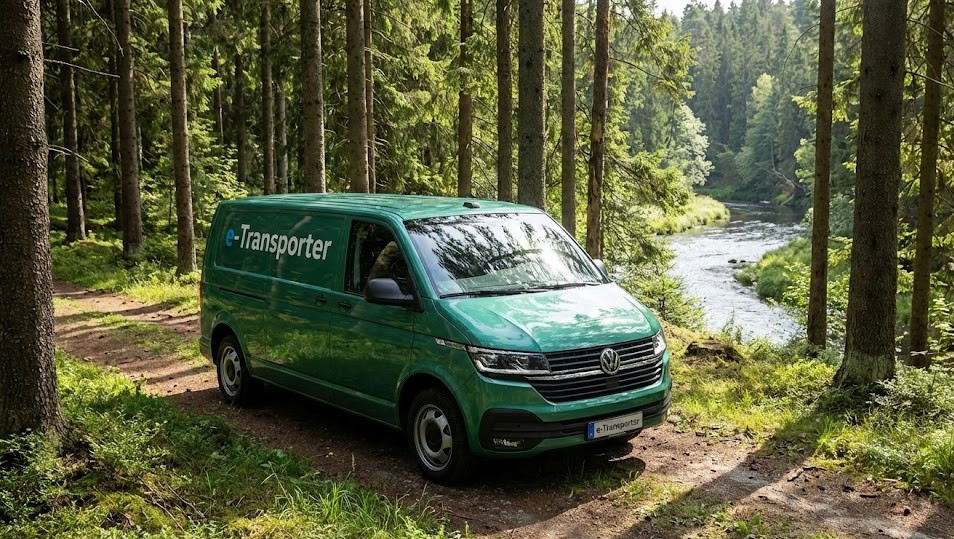
The new VW Transporter shares its platform with the Ford Transit Custom. For some Transporter loyalists, this is difficult to accept. For others, it’s a sensible partnership that delivers a capable electric van.
What You’re Getting
- Battery: 64kWh useable (the only option currently available)
- Official range: 190-201 miles (WLTP)
- Real-world range: 150-170 miles
- Motorway/cold weather: 130-150 miles
- Rapid charging: 10-80% in approximately 40 minutes at 125kW
The e-Transporter has the smallest battery of the three options. Its real-world range of 150-170 miles is noticeably less than the e-Scudo (170-180) or ID Buzz (180-230). For some use cases this won’t matter; for others, it’s significant.
On the plus side, the smaller battery combined with 125kW charging means it tops up relatively quickly — around 40 minutes to 80%. When you do need to charge, you’re not waiting around.
There’s currently no larger battery option for this platform, although the hybrid PHEV option possibly offers the best of both worlds.
Full Campervan Capability
Like the e-Scudo, the e-Transporter offers everything you’d expect from a traditional campervan conversion — nothing is lost by going electric.
We fit these with a Reimo pop-top roof and the Reimo Vario rocknroll bed on rails, both designed specifically for this van by the German manufacturer. We also offer a slat bed option if you prefer.
Gas or electric cooking, off-grid heating, 4-berth with the pop-top, it’s all available. The interior space is similar to the e-Scudo, with a traditional Transporter layout that’s well-suited to campervan conversion.
The e-Transporter is Right For You If:
- You want the Transporter name and layout, but electric
- Full traditional campervan capability matters (off-grid heating, 4-berth, pop-top)
- The Reimo pop-top and Vario rocknoll bed appeal to you
The e-Transporter is NOT Right For You If:
- You need maximum range — the 64kWh battery gives less than the e-Scudo or Buzz
Heating your electric campervan: and why it matters so much
This is the section that most electric campervan content glosses over. It shouldn’t be—it’s one of the most important factors in choosing a base vehicle.
Understanding Your Campervan’s Electrical System
Your campervan’s habitation system runs on a separate 12V leisure battery—not your vehicle’s main traction battery. This is crucial to understand.
Your home runs on 230V, which makes powering heaters straightforward. Your campervan runs on 12V. And 12V simply isn’t powerful enough to generate meaningful heat for extended periods.
Why You Can’t Just Use an Electric Heater Off-Grid
A typical electric space heater draws 2,000-3,000W and needs to run for hours. Could you theoretically power one from a lithium battery and inverter? Briefly. But you’d drain even a large battery bank in a few hours, and your solar panels can’t replenish that overnight—especially on short winter days.
A fully electric off-grid heating system that actually works would require a battery bank so large it would fill your cupboards, add hundreds of kilograms to your vehicle, and cost more than most conversion budgets.
The Two Approaches to heating your electric camper
Off-Grid Heating (e-Scudo and e-Transporter)
A Propex gas heater runs independently of your electrical system. It uses minimal power for the fan and controls, while the heat comes from a small gas bottle. This gives you reliable warmth and hot water anywhere, regardless of weather or battery state.
We can install this in the e-Scudo and e-Transporter because both chassis allow safe gas fitting.
Vehicle Heating + Hook-up + 12V Solutions (ID Buzz)
The ID Buzz is the exception — its chassis design doesn’t allow off-grid heating installation.
Buzz owners use a combination:
- Vehicle heating for warming the space
- Campsite hook-up when available
- 12V electric blankets for sleeping
- Quality insulation to retain heat
This works well for three-season camping and campsite-based trips. It’s a different approach, and many owners are genuinely happy with it.
What This Means For Your Choice
If year-round off-grid camping matters to you, the e-Scudo and e-Transporter both offer off-grid heating. If you’re primarily a three-season camper who uses campsites in colder months, the Buzz’s approach works well.
Neither is wrong, they’re different.
Real-World Range: Honest Numbers
One of the most important factors when choosing your electric van for conversion is the ‘Real-World Range’. Manufacturer WLTP figures are tested in optimised conditions. Real-world driving—especially with a converted campervan carrying passengers and gear—delivers less.
| Vehicle | WLTP Range | Real-World Range |
| Fiat e-Scudo 75kWh | 205-219 miles | 170-180 miles |
| VW ID Buzz 86kWh | 234-291 miles | 180-230 miles |
| VW e-Transporter 64kWh | 190-201 miles | 150-170 miles |
The above features real-world figures based on independent testing by Car and Driver, MotorTrend, What Car?, and Van Reviewer.
In practice:
- Weekend trips (100-150 miles each way): All three handle this comfortably
- Week-long touring: Charge every 2-3 days; the Buzz gives you the most flexibility
- Daily use with home charging: All three work well
Charging Infrastructure
As of late 2025, there are nearly 87,000 public charging points across the UK—a 22% increase year-on-year. The rapid and ultra-rapid network (50kW+) now includes over 17,000 chargers.
For trip planning, we recommend the Zapmap app—it shows real-time availability and helps you plan routes with charging stops.
| Vehicle | Rapid Charge (10-80%) | 7kW Home/Campsite |
| e-Scudo | ~45 mins @ 100kW | ~11 hours |
| ID Buzz | ~26-33 mins @ 200kW | ~11 hours |
| e-Transporter | ~40 mins @ 125kW | ~8-9 hours |
The ID Buzz charges fastest thanks to its 200kW capability. The e-Transporter’s smaller battery means it fills up quicker than the e-Scudo despite the lower charging speed.
Electric Vans for Conversion Comparison Table
| Fiat e-Scudo | VW ID Buzz | VW e-Transporter | |
| Key Advantage | Best range with off-grid heating, Stellantis sourcing | Best overall range, iconic styling, fastest charging | Transporter name, Reimo pop-top and bed |
| Battery | 75kWh | 86kWh | 64kWh |
| Real-World Range | 170-180 miles | 180-230 miles | 150-170 miles |
| Rapid Charge | ~45 mins | ~26-33 mins | ~40 mins |
| Off-Grid Heating? | ✅ Yes | ❌ No | ✅ Yes |
| 4-Berth? | ✅ Yes | ✅ Yes (tighter) | ✅ Yes |
| Interior Width | 1,628mm | 1,230mm | ~1,780mm |
| Used Base Vehicle | £20,000 | £30,000 | £32,400 |
| Conversion From | £21,000 | £21,000 | £31,000 |
What You Get with a Sunbox Campers Conversion
Why choose us?
- We’re a design-led company — more atelier than factory. We build beautiful campervans that look lovely and work as they should.
- Sustainability matters to us, so we use natural materials wherever possible: FSC-certified wood, Thermafleece insulation (sheep’s wool), Chieftain Earthly fabrics (100% recycled). Every van is built by skilled craftspeople.
- We work at a relatively small scale, offering variations of tried and tested designs. This lets us focus on getting each van right for the customer who’ll be living with it. We know this is a huge commitment and we build our campers with that in mind.
- We are proud to be at the forefront of the electric campervan conversion movement. As electric van conversion specialists, we innovated early, developing designs for new zero-emission chassis as soon as they hit the market. Our technical expertise ensures you get the best electric van conversion—optimised for range, efficiency, and true sustainable van life.
Next Steps
If you know which van interests you: Get in touch to discuss conversion options and timelines.
If you’re still deciding: Book a phone consultation. We’ll discuss how you plan to use your campervan and help you figure out which platform makes sense.
If you want to see examples: Browse our completed conversions, or ask about viewing a finished van in person.
Contact us by email at hello@sunboxcampers.co.uk