

Electric campervans are brilliant. Quiet, smooth, cheap to run, and increasingly practical as charging infrastructure grows. But full electric isn’t right for everyone’s situation — at least not yet. If you’ve decided that full electric doesn’t quite fit how you use a campervan, a plug-in hybrid (PHEV) might be worth considering. Here’s what you need to know.
What is a PHEV Campervan?
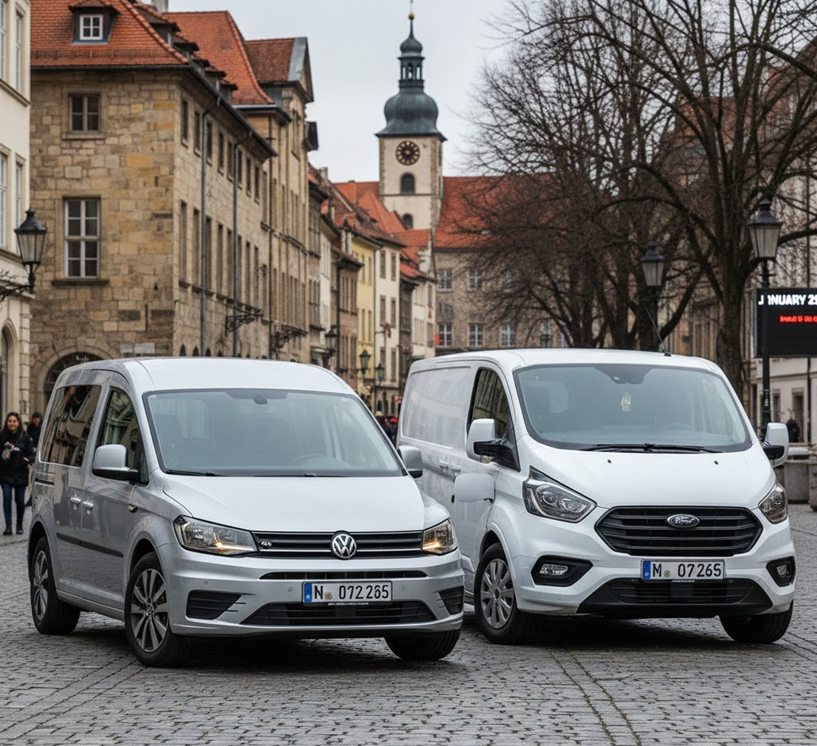
A plug-in hybrid combines a conventional petrol engine with an electric motor and battery. You can charge it from a plug (hence “plug-in”), and it will run on electric power alone for shorter distances — typically 35-75 miles depending on the vehicle and conditions.
When the battery runs low, or when you need more power, the petrol engine takes over. The transition is seamless — you don’t have to do anything.
For a campervan, this means you can drive electrically for shorter trips and daily use. Longer journeys use petrol, just like any conventional van.
Who is a PHEV Campervan For?
The PHEV suits people who’ve decided that full electric isn’t quite right for their situation at the moment.
You might choose a PHEV if:
- You regularly do very longer trips. If Scotland, France, or multi-week touring is your thing, you might not want to plan around charging stops.
- Charging infrastructure doesn’t work for you. Perhaps your favourite spots don’t have charging nearby. Perhaps you don’t have home charging. The PHEV removes that concern.
- You want to experience electric driving before committing to a fully electric vehicle. A PHEV lets you get comfortable with electric before committing fully. You might find you love it and go fully electric next time.
- You prefer the flexibility. Some people just feel better knowing they can fill up at any petrol station or electric charging point. That’s a valid choice.
How You Might Use a PHEV Campervan
Here’s what a PHEV campervan experience might look like in practice.
Daily driving: If you use your campervan as a daily vehicle, most short trips happen on electric. School runs, shopping, errands — all quiet, all electric, all cheap. Charge overnight at home and you rarely touch petrol for everyday use. The Caddy eHybrid’s 70+ mile electric range means most daily driving never touches petrol at all.
Weekend trips: Drive to the campsite on petrol if it’s far or electric if its nearer. If there’s hook-up, you can charge while you’re there.
Longer tours: For a two-week long distance tour, you’re mostly using petrol for the touring and electric for the day trips and pootling around.
What a PHEV Campervan Doesn’t Do
Let’s be clear about limitations.
It’s not a full electric experience. You’re still carrying a petrol engine and using it for longer journeys. If you want to move away from fossil fuels entirely, a fully electric campervan (like our e-Scudo or ID Buzz conversions) is the way to go.
Incentives vary by electric range. The Plug-in Van Grant requires 60+ miles of electric range. The Caddy eHybrid qualifies (70-74 miles); the Transit Custom PHEV doesn’t (~35 miles). Neither gets the same tax benefits as fully electric vehicles, and company car rates are higher than pure EVs. If financial incentives are your main motivation, full electric is usually the better choice — but the Caddy at least gets the grant.
Electric range varies significantly. The Caddy eHybrid offers around 70-74 miles; the Transit Custom PHEV around 35 miles. Neither will get you from London to Edinburgh on electric alone — but for local use and daily driving, they’re transformative.
Two PHEV Campervan Options
We offer PHEV conversions on two platforms, each suited to different needs:
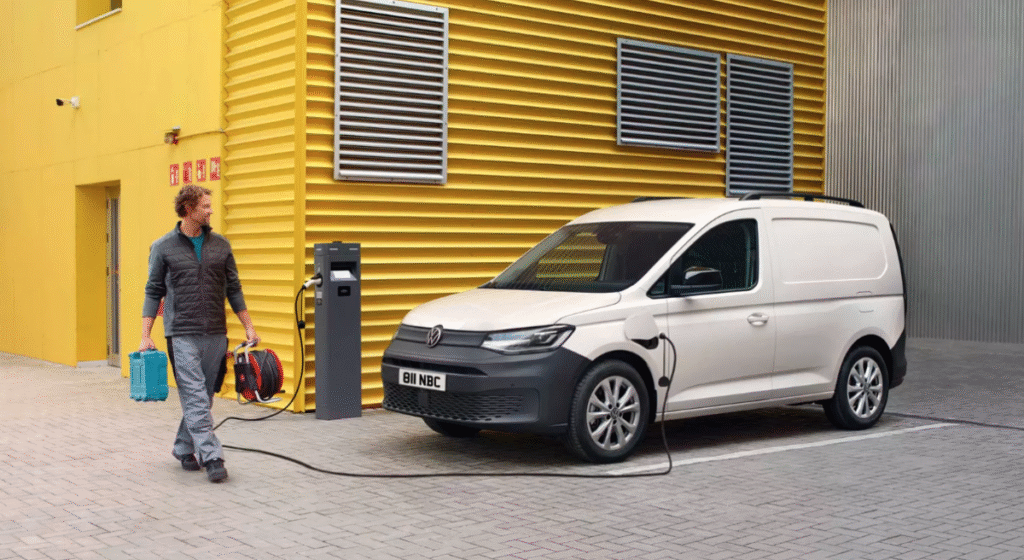
VW Caddy Maxi eHybrid — The Compact PHEV Campervan
The Caddy Maxi eHybrid is our smaller PHEV option — perfect for couples or solo travellers who want a nimble campervan that’s easy to drive and park.
The Caddy uses VW’s own car-derived PHEV system: a 1.5 TSI petrol engine paired with a 114hp electric motor and 19.7kWh battery. This is the same hybrid technology VW fits to the Golf GTE, Tiguan eHybrid, and Passat eHybrid — proven, refined, and familiar to every VW dealer.
Key specs:
- Electric range: 70-74 miles (WLTP) — enough for most daily driving
- Combined power: 150hp
- Battery: 19.7kWh
- Gearbox: 6-speed DSG automatic
- Sleeping: 2-berth (comfortable double bed)
- Plug-in Van Grant: Yes — qualifies (60+ mile range requirement met)
Why the Caddy? If you want the longest electric range, VW’s PHEV expertise, government grant eligibility, and a compact campervan that works as a daily driver, the Caddy eHybrid is hard to beat. It’s also cheaper than the Ford Transit Connect PHEV (which uses the same VW system but with Ford badges) — so you get VW engineering, VW dealer support, the grant, and a lower price.
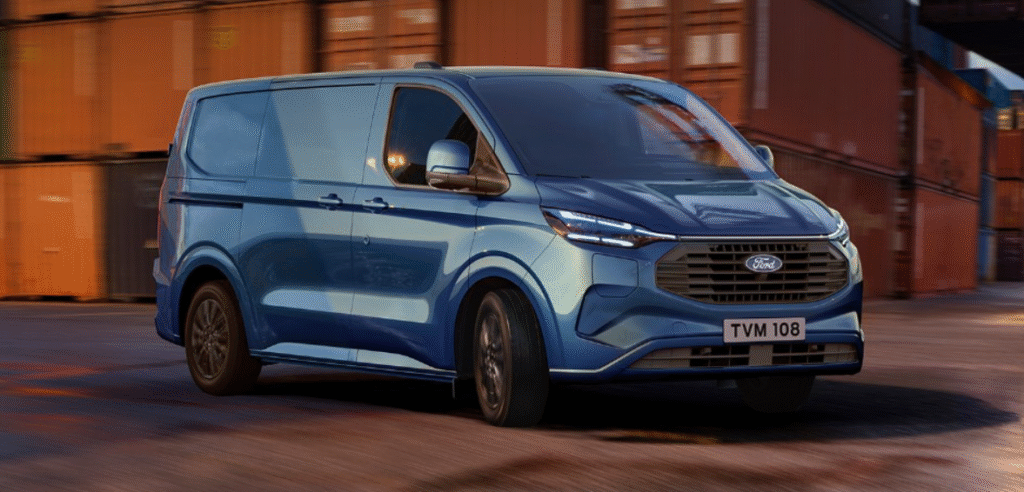
Ford Transit Custom PHEV — The Family PHEV Campervan
The Transit Custom PHEV is our larger PHEV option — a proper mid-size campervan with genuine 4-berth capability when fitted with a pop-top roof.
The Transit Custom uses Ford’s commercial van PHEV system: a 2.5L Atkinson-cycle petrol engine paired with an electric motor and 11.8kWh battery. This is the same hybrid technology Ford fits to the Kuga PHEV — and Ford has been developing commercial van PHEVs since 2019.
Key specs:
- Electric range: Up to 35 miles (WLTP)
- Combined power: 232hp
- Battery: 11.8kWh
- Interior width: ~1,780mm between wheel arches
- Sleeping: Up to 4-berth (with Reimo pop-top roof)
- Plug-in Van Grant: No — doesn’t meet 60-mile range requirement
Why the Transit Custom? If you need space for a family, want a rocknroll bed or on rails, or prefer the familiar Transporter-style layout, the Transit Custom is the choice. It shares its platform with the VW Transporter T7 — same body, same dimensions — but the Ford PHEV is available now (the VW Transporter eHybrid isn’t expected until 2026).
Which PHEV Should You Choose?
- Choose the Caddy eHybrid if: You’re a couple or solo traveller, you want maximum electric range (70+ miles), you want the Plug-in Van Grant, you prefer a compact van that’s easy to park and drive daily, or you want VW’s car-derived PHEV system.
- Choose the Transit Custom PHEV if: You need 4-berth family capability, you want a pop-top roof, you prefer the larger Transporter-style layout, or you want Ford’s commercial van PHEV expertise.
Both are excellent choices. The right one depends on your situation.
A Note on the Ford-VW Partnership
If you’re wondering why we recommend the VW for the small van and Ford for the medium van, there’s a strategic reason.
Ford and VW have a partnership where each company leads on what they do best. For PHEV technology, this splits cleanly by platform type:
- Car-based platforms (like the Caddy): VW leads. The Caddy uses VW’s MQB platform and VW’s 1.5 TSI hybrid system.
- Commercial van platforms (like the Transit Custom): Ford leads. The Transit Custom uses Ford’s own platform and Ford’s 2.5L Atkinson hybrid system.
This means each brand has years of expertise with their respective PHEV systems — and their dealer networks know how to service them. Go with VW for the Caddy, Ford for the Transit Custom, and you’re getting the expert’s version.
For the full story, see our blog: The Ford-VW Partnership Explained
Or Go For a Fully Electric Campervan
If you think full electric might work for your situation, it’s worth considering. Our e-Scudo and ID Buzz conversions are excellent campervans, and many customers love them.
Electric campervans work well for people who:
- Do mostly shorter trips (weekend breaks, UK touring)
- Are comfortable planning around charging
- Have home charging available
- Want the full benefits of electric — quiet, smooth, low running costs, zero local emissions
We’re happy to talk through which option makes sense for your situation. There’s no hard sell — just honest advice based on how you actually plan to use the van.
About Sunbox Campers
We’re the UK’s electric campervan specialists, based in East Sussex. We build beautiful handcrafted conversions using sustainable materials — FSC wood, Thermafleece insulation, quality throughout.
Our range includes:
- Fiat e-Scudo — fully electric, up to 205 miles range
- VW ID Buzz — fully electric, iconic design
- VW Caddy Maxi eHybrid — plug-in hybrid, 70+ miles electric range, Plug-in Van Grant eligible, VW’s car-derived PHEV expertise
- Ford Transit Custom PHEV — plug-in hybrid, 4-berth capability, Ford’s commercial van PHEV expertise
Get in touch to discuss your requirements. We’re here to help you find the right campervan — whatever that looks like for you.
Related Reading
- The Ford-VW Partnership Explained
- VW Caddy Maxi eHybrid Conversions
- Ford Transit Custom PHEV Conversions
- Fiat e-Scudo Conversions
- VW ID Buzz Conversions