

The Factory Electric Campervan That Everyone’s Waiting For – And Why You Might Not Want To Wait
If you’re dreaming of an all-electric VW campervan with that iconic California badge, you’re not alone. Ever since Volkswagen confirmed the ID California in December 2021, campervan enthusiasts have been eagerly awaiting the first fully electric factory campervan from the brand that invented the segment.
But here’s the reality: the ID California keeps getting delayed, and there’s still no confirmed launch date. If you’re planning your electric campervan purchase around the ID California’s arrival, you need to understand what’s actually happening — and what alternatives are available right now.
This guide covers everything we currently know about the VW ID California, why it’s been delayed, what to expect when it finally arrives, and what you can do in the meantime if you don’t want to wait another 5-10 years.
Spoiler: If you want the iconic VW electric campervan experience now, our ID Buzz conversions deliver exactly that — without waiting for a factory product that may never arrive.
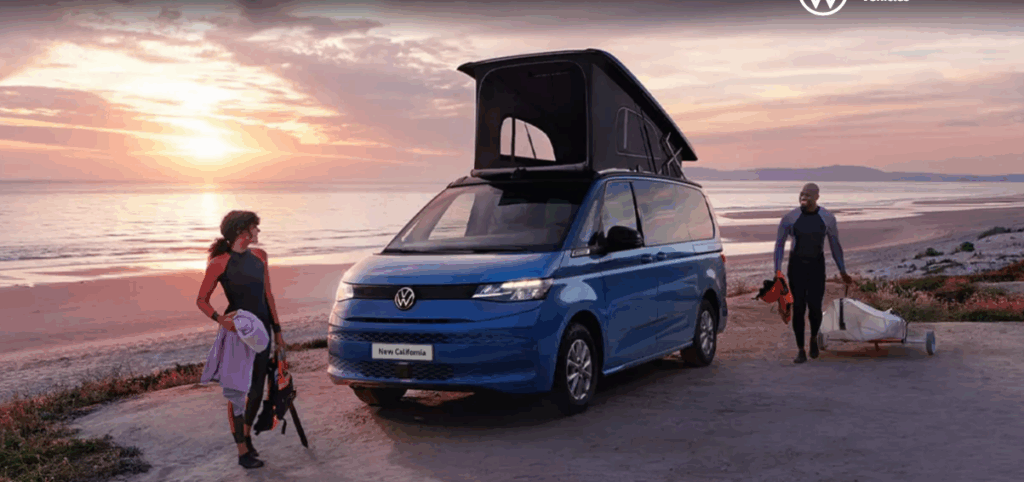
Quick Summary: VW ID California Status
| Question | Answer |
| Is the ID California confirmed? | Announced December 2021 — but never guaranteed |
| When will it launch? | Unknown — realistically early-to-mid 2030s (if at all) |
| What’s causing the delay? | Weight/payload challenges + stated low demand + US market uncertainty (tariffs) |
| What platform? | ID Buzz Long Wheelbase (LWB) — if it proceeds |
| UK availability? | Highly uncertain |
| Expected price? | £75,000-£85,000+ (estimated) |
| Can I buy an electric California now? | No factory option — but Sunbox ID Buzz conversions are available today |
What is the VW ID California?
The VW ID California is Volkswagen’s planned fully electric campervan, based on the ID Buzz platform. It was announced by VW’s supervisory board in December 2021, with an expected launch “in the second half of the decade.”
But here’s what VW hasn’t said: that it will definitely happen.
The ID California has never been formally confirmed with a launch date, final specifications, or pricing. It remains a stated intention rather than a committed product — and recent developments with the ID Buzz itself have raised serious questions about whether it will ever arrive.
This represents a significant change from recent California history. The previous T5 California (2003-2015) and T6/T6.1 California (2015-2024) were based on the Transporter — VW’s commercial van platform. But the current T7 California (launched 2024) breaks from this tradition: it’s based on the Multivan, which uses VW’s MQB passenger car platform — the same architecture as the Golf and Passat.
The ID California will be different again: a pure battery electric vehicle based on VW’s MEB platform, shared with the ID Buzz and other ID-series vehicles. It continues VW’s electric transformation while honouring the legendary California campervan heritage.
What VW Has Officially Confirmed
- Name: VW ID California (not “ID Buzz California”) — source
- Platform: Based on the ID Buzz Long Wheelbase (LWB)
- Production location: Hannover, Germany
- Launch timing: VW said “second half of the decade” in 2023 — but this was before they launched the T7 California in 2024 (see below)
- Board approval: December 2021
But here’s the thing: VW launched the T7 California in 2024. That decision effectively supersedes any earlier timeline for the ID California. Here’s how California generations have historically played out:
| Generation | Years | Duration |
| T3 California | 1988-1990 | ~2 years (end of T3 era) |
| T4 California | 1990-2003 | ~13 years |
| T5 California | 2003-2015 | ~12 years |
| T6/T6.1 California | 2015-2024 | ~9 years |
| T7 California | 2024-? | Just launched |
The T3 California was short-lived because it came at the very end of the T3 platform — VW was already transitioning to the T4. Since then, every California generation has run 9-13 years.
Could the T7 California be similarly short-lived? It’s possible. The Multivan platform has an uncertain future — VW paused production at the Hanover plant in late 2025 due to slow sales of both the ID Buzz and Multivan. The T7 California could be a transitional product, keeping the California line alive while VW waits for the ID Buzz and battery technology to mature.
Could VW extend the T7’s life with an electric Multivan? In theory, yes — they could develop a pure electric version of the Multivan to give the T7 California a longer runway. But there’s no sign of this happening. The MQB platform the Multivan uses isn’t designed for pure electric (only PHEV), and VW’s electric investment is going into the MEB platform that underpins the ID range. An electric Multivan would require significant investment in a platform with uncertain demand.
If the T7 is treated as a short transitional generation like the T3, we might see an ID California sooner than the 9-13 year pattern would suggest. But even in that optimistic scenario, “sooner” likely means late 2020s at the earliest. VW still needs to solve the weight challenges, and they’re unlikely to undercut T7 California sales immediately after launch.
Our realistic prediction: The ID California is more likely in the early-to-mid 2030s — but could potentially arrive late 2020s if VW treats the T7 as a short transitional generation. Either way, we’re talking 5-10 years, not 2-3.
What VW Hasn’t Confirmed
- Exact launch date
- Final specifications
- UK pricing
- UK availability timeline
- Conversion partner (in-house VW or external like Westfalia)
- How they’ll solve the heating challenge
A Brief History: How We Got Here
Understanding the ID California means understanding what came before:
| Generation | Years | Platform | Engine Options |
| T3 California | 1988-1990 | T3 Transporter | Petrol, Diesel |
| T4 California | 1990-2003 | T4 Transporter | Petrol, Diesel |
| T5 California | 2003-2015 | T5 Transporter | Diesel |
| T6/T6.1 California | 2015-2024 | T6 Transporter | Diesel |
| T7 California | 2024-present | Multivan (MQB platform) | Diesel, Petrol, PHEV |
| ID California | TBC (2030s?) | ID Buzz (MEB platform) | Pure electric |
The shift from Transporter to Multivan for the T7 was significant. The T7 California is now based on VW’s car platform rather than a commercial van — making it more car-like to drive but also representing a departure from the California’s van-based heritage.
The ID California will continue this trend toward car-derived platforms, being based on the passenger-focused ID Buzz rather than a commercial vehicle.
Why Has the ID California Been Delayed?
The ID California was originally expected around 2025. That date has slipped significantly, with VW now indicating “late in the decade” — potentially 2027-2030. Several factors are behind the delay:
1. Weight and Payload Challenges
This is the biggest technical hurdle. The ID Buzz LWB has a gross vehicle weight rating (GVWR) of around 3,000kg. Once you add:
- Pop-top roof mechanism
- Kitchen unit (sink, hob, fridge)
- Rock and roll bed system
- Water tanks (fresh and waste)
- Leisure battery system
- Insulation and interior furniture
- Driver, passengers, and luggage
…you risk exceeding the 3,500kg limit that can be driven on a standard car licence (Category B) in Europe. Exceeding this would require customers to hold a Category C (truck) licence — a dealbreaker for most buyers.
And here’s the counterintuitive part: the LWB actually has less payload than the SWB. The ID Buzz LWB 7-seater has a payload of just 545kg — compared to around 600kg for the SWB versions. The larger 86kWh battery, longer body, more powerful motor, and third-row seat mechanisms all add weight that eats directly into payload capacity.
That’s remarkably tight for a full campervan conversion with passengers and camping gear. VW’s engineers are reportedly working to reduce conversion weight or waiting for lighter, higher-density battery technology to become available.
Edison Media reported in August 2023 that weight issues were causing development problems, with the risk of the vehicle exceeding licence limits.
This is exactly the challenge we’ve solved with our ID Buzz conversions. Our E-Chamonix conversion weighs around 2,600kg complete — leaving 400kg+ payload for passengers and gear. The difference? We use lightweight sustainable materials and design specifically for electric vehicles, not mass-market compromises.
2. “Insufficient Demand” — According to VW
In May 2024, VW Commercial Vehicles CEO Prof Dr Carsten Intra stated that VW doesn’t currently see sufficient demand for a pure electric campervan to justify the launch. This is a surprising statement given the enthusiasm in the campervan community, but it reflects VW’s commercial calculations for a mass-market product.
Motor Authority reported that Intra indicated VW expects demand to grow “to a sufficient level by the second half of the decade.”
We see plenty of demand. Our order book tells a different story — people want electric campervans now, they just can’t get them from factories. VW is waiting for mass-market scale; we’re building for customers who are ready today.
3. The T7 California as a Stopgap
Rather than rushing the ID California, VW has launched the T7 California — but importantly, this is no longer based on the Transporter like previous generations.
The T7 California is based on the Multivan, which uses VW’s MQB passenger car platform. This represents a significant departure from the T5 and T6 Californias, which were based on the commercial Transporter van.
The T7 California offers:
- Diesel (150hp)
- Petrol (204hp)
- Plug-in hybrid eHybrid (245hp combined) with 54 miles electric range
From VW’s perspective, the T7 eHybrid buys time without losing customers to competitors. Whether 54 miles of electric range satisfies those wanting a truly electric campervan is another question.
4. US Market Uncertainty
The ID Buzz’s struggles in America matter for the ID California — because the US would be a natural mass market for an electric campervan.
In December 2025, VW announced it would skip the 2026 model year for the ID Buzz in the US market. The reasons are largely US-specific:
- 25% tariffs on German imports making the business case difficult
- High pricing ($61,545+) in a market used to cheaper vehicles
- Fewer than 5,000 units sold through September 2025
- Expiration of federal EV tax credits
The ID Buzz sells better in Europe — where it’s priced more competitively, tariffs aren’t an issue, and the campervan culture is stronger. But VW’s uncertainty about its commercial future in America likely affects their appetite for investing in derivatives like the ID California, which would need US sales to justify development costs.
Until VW has a clearer picture of its American strategy, committing to an expensive campervan project makes less commercial sense.
5. No LWB Cargo Available in the UK
Here’s an important detail for UK buyers watching this space: the ID Buzz LWB Cargo — which would likely form the basis of any ID California — isn’t currently available in the UK.
- ID Buzz SWB (5-seater passenger)
- ID Buzz LWB (6/7-seater passenger)
- ID Buzz Cargo SWB (commercial van)
- ID Buzz GTX (performance variant)
But no LWB Cargo variant. As Carwow notes, the ID Buzz Cargo “is only available in one body style” — unlike competitors that offer varying heights and wheelbase lengths.
Whether VW will release the LWB Cargo in the UK before (or alongside) the ID California remains unclear.
6. The LWB Paradox: Bigger Isn’t Always Better
Here’s something counterintuitive that VW’s engineers are grappling with — and that we’ve learned from years of converting electric campervans:
The LWB ID Buzz actually offers a worse space-to-weight ratio for campervan use than the SWB.
The extra 250mm of length comes with significant weight penalties: larger 86kWh battery (vs 79kWh), more powerful motor, longer body structure, and third-row seat mechanisms. The result? The LWB has less payload (545kg) than the SWB Cargo (592-607kg).
For a campervan, this matters enormously. You’re adding conversion weight (furniture, bed, kitchen, water, roof) to a vehicle that already has less margin for payload than its shorter sibling.
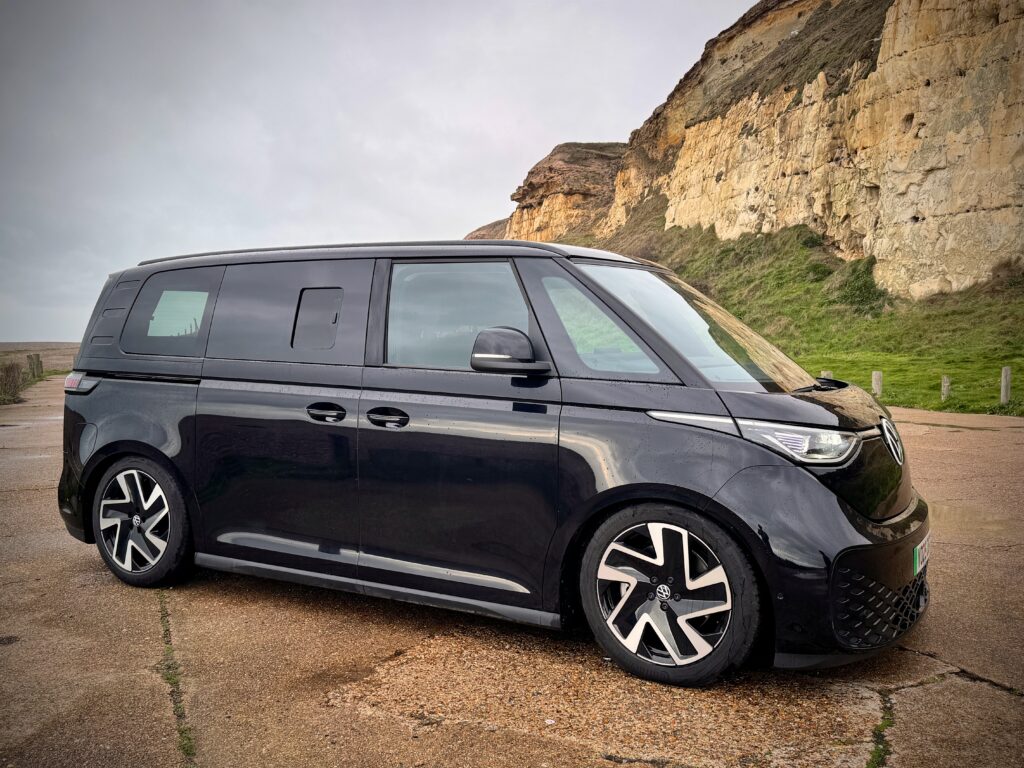
This is why we convert the SWB ID Buzz Cargo at Sunbox Campers. The shorter wheelbase gives us:
- Better payload headroom for passengers and gear
- More efficient use of the available space
- Lower base vehicle weight
- Often better real-world range (smaller battery, but less weight to move)
The SWB is sometimes dismissed as “too small” — community forums are full of comments like “more Caddy than California.” But when you’re working with electric vehicle weight constraints, intelligent design in a smaller package often beats brute size. It’s the same philosophy that makes our microcamper conversions so effective — and why our ID Buzz customers consistently tell us it’s more spacious than they expected.
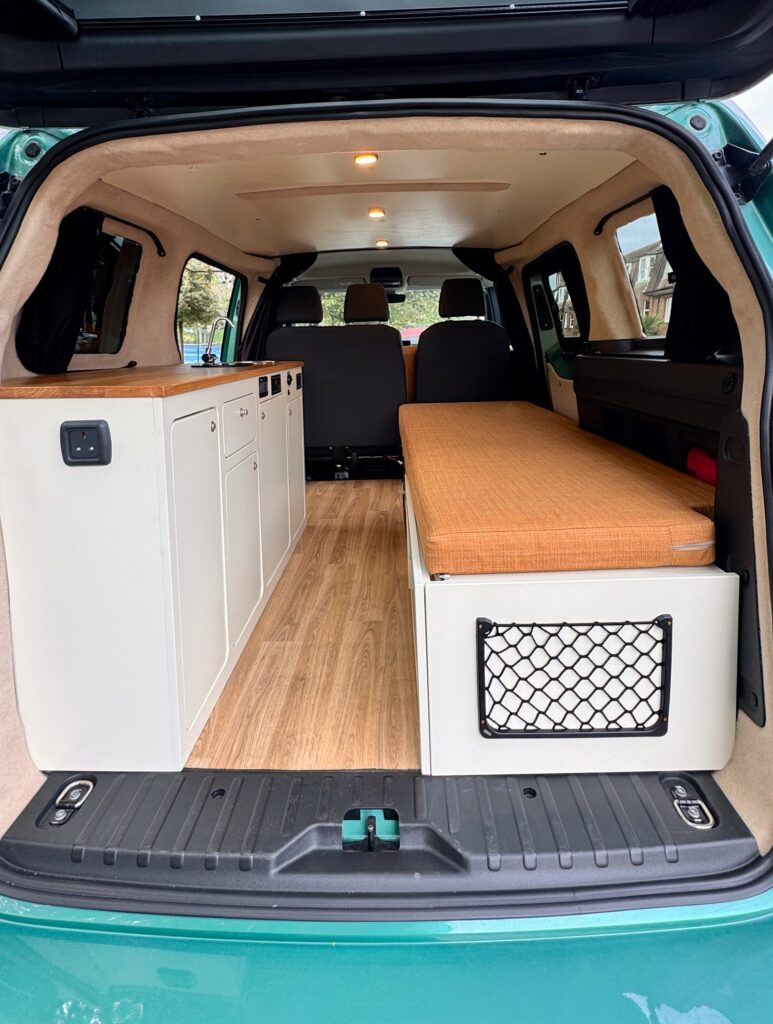
What Will the ID California Likely Include?
Based on the ID Buzz LWB specifications and traditional California features, here’s what we expect:
Platform and Dimensions
| Specification | Expected ID California |
| Platform | VW MEB (ID Buzz LWB) |
| Length | ~4,962mm |
| Wheelbase | ~3,238mm |
| Width | ~1,985mm |
| Height | ~1,927mm + pop-top |
For comparison, the current T7 California measures 5,173mm long — slightly longer than what we’d expect from an ID Buzz-based California.
Battery and Range
| Specification | Expected | Notes |
| Battery capacity | 91kWh (gross) | Current ID Buzz LWB spec |
| Real-world range | 200-250 miles | Depending on load and conditions |
| DC fast charging | Up to 200kW | ID Buzz LWB spec |
| AC charging | 11kW | Standard ID Buzz spec |
| Charge time (10-80%) | ~30 minutes | DC fast charging |
Range will be significantly affected by campervan weight. Expect real-world figures toward the lower end when fully loaded with passengers and camping gear.
Powertrain Options
Based on current ID Buzz offerings:
- Single motor RWD: 286hp — ID Buzz LWB Pro spec
- Dual motor AWD (GTX): 340hp — ID Buzz GTX spec
The GTX variant might be offered to provide additional towing capacity (up to 1,800kg vs 1,000-1,200kg for standard models), though it would come with higher weight and potentially reduced range.
Habitation Power: How Will VW Handle It?
Traditional VW Californias don’t have a separate leisure battery — they run habitation electrics (lights, fridge, USB sockets) from the vehicle’s 12V system, kept charged by the engine. It’s a simpler, lighter approach than the separate leisure battery systems used in most campervan conversions.
For a pure electric ID California, VW has two options:
- Add V2L (Vehicle-to-Load) capability — allowing the main drive battery to power habitation loads directly. The current ID Buzz doesn’t have this (no onboard inverter or AC outlet), but it’s a software and hardware addition that other manufacturers like Hyundai and Kia already offer. VW could add this for the ID California.
- Install a separate leisure battery — the standard approach for campervan conversions, but adds weight that VW is already struggling with.
Either approach is technically solvable. We’d expect VW to favour V2L to keep the California’s traditionally integrated design and avoid the weight penalty of a separate battery system.
The Heating Question: VW’s Biggest Challenge
Heating is one of the biggest challenges for electric campervans — and one we’ve written about extensively in our complete guide to electric campervan heating.
The T7 California eHybrid includes a petrol engine that can provide heat, and traditional diesel Californias use Webasto or Eberspächer diesel heaters. But a pure electric ID California has no combustion engine.
And here’s the critical issue: based on the ID Buzz’s chassis design, it almost certainly cannot accommodate aftermarket gas heating systems.
This is fundamentally different from commercial van platforms like the Fiat e-Scudo or VW e-Transporter, where the chassis design allows safe installation of LPG/propane heating systems.
Expected Heating Solutions for the ID California
- Vehicle heat pump: The ID Buzz’s efficient heat pump can warm the cabin effectively, but draws from the main battery — reducing driving range
- Auxiliary electric heater: Possible 230V heater for campsite hook-up use
- Preconditioning: Warm the van while plugged in before departure
- V2L power station: Use vehicle-to-load to power portable electric heaters (again, drawing from main battery)
What This Means Practically
For spring-to-autumn camping and regular campsite use with electric hook-up, these solutions will work well. The ID California will be comfortable and practical for the majority of UK camping trips.
For extended off-grid winter camping — the kind where you’re parked up in the Scottish Highlands in February — the lack of gas heating is a genuine limitation. You’d be relying on the main battery for heat, which directly reduces your driving range the next day.
If year-round off-grid capability is essential for you, this is one area where our e-Scudo conversions have a clear advantage over any ID Buzz-based campervan — factory or converted. The e-Scudo’s chassis allows us to install Propex gas heating for reliable warmth without touching your driving range.
Expected Pricing
VW hasn’t announced pricing, but we can estimate based on current models:
| Model | Price | Source |
| ID Buzz LWB Style | £64,345 | Motor1 |
| ID Buzz GTX | £67,795 | EV Database |
| T7 California Ocean eHybrid | £77,840 | VW UK |
| Traditional California premium | ~£15,000-£20,000 | Over base Multivan |
Expected ID California pricing: £75,000-£90,000+
This positions it at the premium end of the factory campervan market, similar to or above the Mercedes Marco Polo (£88,000-£98,000+).
For context, a Sunbox ID Buzz conversion — including the base vehicle — typically costs £55,000-£65,000. That’s the same platform, the same iconic styling, available now rather than in 2030+, and bespoke to your exact requirements. The factory version will cost significantly more and offer less flexibility.
When Will the ID California Actually Launch? (If It Does)
Based on everything VW has said (and hasn’t said), plus the current state of the ID Buzz:
| Scenario | Estimated UK Launch | Reasoning |
| Optimistic | 2028-2029 | If weight issues resolved quickly and VW accelerates development |
| Realistic | Early-to-mid 2030s | Allows T7 California to run its natural 9-12 year cycle, battery tech to mature, global EV campervan market to develop |
VW has consistently said “second half of the decade” without committing to anything more specific. Given the technical challenges, stated demand concerns, and the absence of the LWB Cargo in the UK, we wouldn’t expect UK deliveries before 2028 at the earliest — if the project proceeds at all.
The ID Buzz Is the Natural Home for the California — Eventually
Some have speculated that VW might use the e-Transporter (based on Ford Transit Custom) for a future electric California. We don’t think so.
The California is VW’s premium campervan brand — arguably their most iconic product in the segment they invented. VW isn’t going to put that badge on a platform they share with Ford. It would massively dilute the brand.
The T7 California’s move to the Multivan platform was almost certainly a stopgap — a way to keep the California line alive while the ID Buzz matured and the electric campervan market developed. The Multivan itself has an uncertain future, and it’s not a natural campervan base in the way the Transporter was.
The ID Buzz, on the other hand, is perfect California territory. It’s the spiritual successor to the T2 Splitscreen. It’s 100% VW. It has the iconic styling, the heritage connection, and the lifestyle appeal that the California brand demands. When VW does eventually make an electric California, it will almost certainly be on the ID Buzz.
The question isn’t if the ID Buzz becomes a California — it’s when. And given that VW just launched the T7 California in 2024, that “when” is likely the early-to-mid 2030s: enough time for the T7 to run its course, for battery technology to solve the payload problems, and for the global electric campervan market to mature.
The honest answer: the ID California will probably happen — but probably not for another decade.
Or you could have an ID Buzz campervan now. Same platform, same iconic design, same VW heritage — just built by us instead of a factory that isn’t ready yet. See our ID Buzz conversions →
What Are Your Options Right Now?
If you want an electric campervan now — not in 2028 or beyond — you have several excellent alternatives available today:
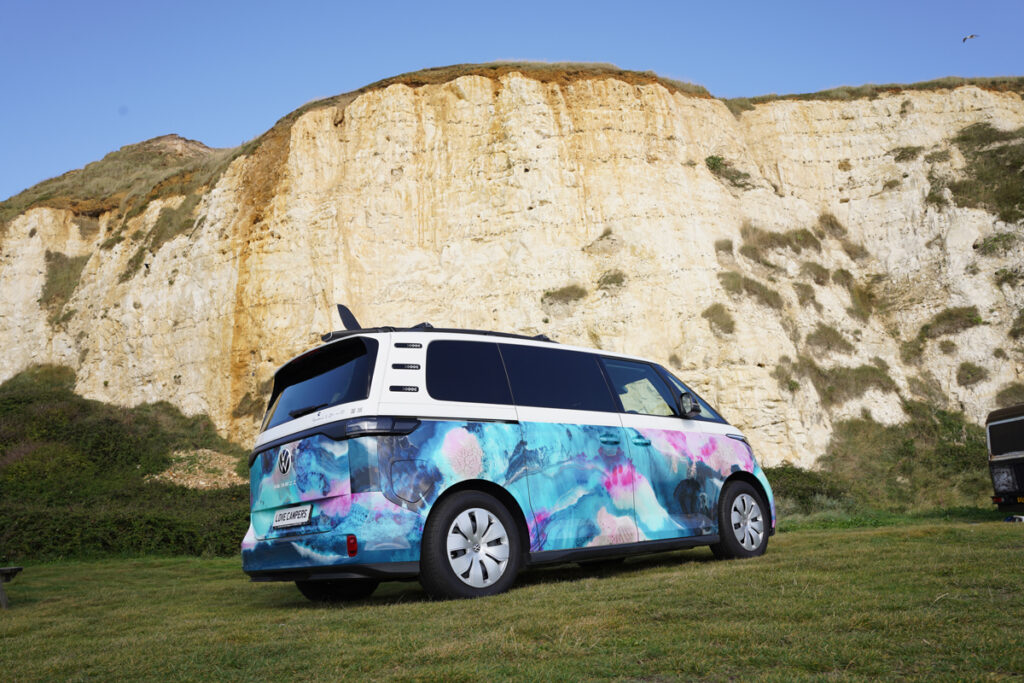
Option 1: Sunbox ID Buzz Conversion — The California You Can Have Now
If you want the iconic VW electric campervan experience, you don’t need to wait for the ID California. Our ID Buzz conversions deliver exactly what people are waiting for — and they’re available now.
We convert the SWB ID Buzz Cargo specifically because (as we explained above) it offers better payload capacity than the LWB. Our E-Chamonix conversion includes:
- Double slat bed for comfortable sleeping
- Fully-equipped kitchen with induction hob
- Optional Horizon pop-top roof for standing room and additional sleeping
- Lightweight construction using sustainable materials (FSC timber, Thermafleece insulation, recycled fabrics)
- Careful weight management — our conversions leave 400kg+ payload for passengers and gear
Why choose an ID Buzz conversion over waiting for the ID California?
| Sunbox ID Buzz | ID California | |
| Available | Now | 2030+? Maybe never |
| Price | From ~£55,000 (vehicle + conversion) | £75,000-£90,000+ (estimated) |
| Customisation | Fully bespoke to your requirements | Factory specification only |
| Weight | Optimised for payload | VW is struggling to make it work |
| Specification | You choose every detail | Unknown |
Our ID Buzz conversions have been featured in Top Gear, Car Magazine, and on the official Volkswagen website. We’ve been converting the ID Buzz since it arrived in the UK and know this platform intimately.
Advantages:
- Available immediately
- Iconic styling and excellent range (180-230 miles real-world)
- Fastest charging of any van we convert (~30 mins to 80%)
- Strong resale value
- Bespoke to your requirements
Limitations:
- Cannot accommodate gas heating (chassis design)
- Smaller interior than traditional Californias or e-Scudo
- Limited off-grid winter camping capability
Learn more about our ID Buzz conversions →
Option 2: Fiat e-Scudo / Stellantis Platform Conversion
The Fiat e-Scudo (and its badge-engineered siblings: Citroën e-Dispatch, Peugeot e-Expert, Vauxhall Vivaro-e) offers a different approach — and solves the heating problem:
Advantages:
- Gas heating can be installed — genuine year-round, off-grid capability
- Larger interior dimensions — sleep 4 inside with pop-top
- Strong second-hand market — excellent value
- 75kWh battery — 170-180 miles real-world range
- Proven commercial vehicle reliability
- True 4-berth capability with belted rear seats
Limitations:
- Less range than ID Buzz
- More utilitarian styling
- Less “lifestyle” brand cachet
Explore our e-Scudo conversions →
Option 3: VW e-Transporter / Ford E-Transit Custom
The new VW e-Transporter (based on Ford Transit Custom platform) offers:
- Up to 236 miles range
- Traditional van proportions familiar to California buyers
- Gas heating possible
- PHEV option also available
Option 4: Wait for the T7 California eHybrid
If you want the California badge and are comfortable with plug-in hybrid rather than pure electric:
- Available now in the UK
- 54 miles electric range — enough for around-campsite driving and short local trips
- Hundreds of miles total range — the petrol engine takes over seamlessly, so no range anxiety on long trips
- Full California specification and equipment
- Petrol engine for longer journeys and reliable heating
- Prices from £63,375 (Beach) to £77,840 (Ocean eHybrid)
Important: Remember the T7 California is based on the Multivan (MQB platform), not the Transporter like previous California generations. Reviews confirm it drives more like a car than a van — smoother, quieter, better handling — which some buyers love, while others find it’s lost some of the T6.1’s practicality and character.
Why Sunbox’s Approach Makes Sense (And What VW Is Learning The Hard Way)
VW’s ID California delays have validated something we’ve known for years: the weight and payload challenges they’re struggling with are exactly what we’ve spent our careers solving.
The Problems VW Is Facing
- The LWB is heavier than the SWB — counterintuitive, but true. More length means bigger battery, longer body, heavier mechanisms.
- 3,500kg licence limit — exceed this and buyers need a truck licence. Non-negotiable.
- One-size-fits-all design — factory products need to work for everyone, which means compromises everywhere.
- No gas heating possible — the ID Buzz chassis can’t accommodate it, limiting year-round use.
How We’ve Already Solved Them
We chose the SWB Cargo deliberately. Not because we couldn’t design for the LWB, but because the SWB offers:
- Better payload (592-607kg vs 545kg)
- Lower base weight
- More efficient space-to-weight ratio
- Often better real-world range
We use lightweight, sustainable materials — not as a marketing angle, but because weight savings on an EV translate directly to payload and range:
- FSC-certified timber (selected for strength-to-weight)
- Thermafleece natural insulation (better insulation per kilogram than synthetics)
- Chieftain Earthly fabric (100% recycled, fire-rated, hard-wearing)
We design bespoke, not mass-market. Every Sunbox conversion is built for an individual customer’s needs. We’re not trying to create one product that works for everyone — we’re creating the right campervan for each person.
The Result
Our ID Buzz conversions weigh around 2,600kg complete — leaving 400kg+ payload for passengers and gear. That’s enough for two adults, camping equipment, and a week’s supplies.
VW’s engineers are working on the same problem we solved years ago. The difference? We’re already building and delivering electric campervans that work.
The factory option may arrive eventually. But “eventually” might be 2030, or never — and that’s a lot of camping trips to miss.
The Bottom Line: Should You Wait for the ID California?
Wait if: You’re willing to risk it never happening.
Consider alternatives now if: You’d prefer to invest in adventures rather than waiting.
Frequently Asked Questions
Q: Is the ID California definitely happening? A: No — and that’s the honest answer. VW announced the project in December 2021 but has never formally committed to a launch date or confirmed specifications. With unresolved weight challenges, US market uncertainty (tariffs, paused 2026 model year), and the stated “insufficient demand” for electric campervans, there’s a real possibility the project could be quietly shelved. VW hasn’t said it’s cancelled — but they also haven’t given any concrete evidence it’s still actively progressing.
Q: Will the ID California come to the UK? A: VW hasn’t confirmed UK-specific plans, but the T7 California sells well here, so UK availability is likely once the vehicle launches in Europe. Note that the ID Buzz LWB Cargo — which would likely form the basis — isn’t currently available in the UK market.
Q: How much will it cost? A: Expect £75,000-£90,000+ based on current California and ID Buzz pricing. Premium specifications could exceed £95,000. For comparison, a Sunbox ID Buzz conversion (including vehicle) typically costs £55,000-£65,000.
Q: Will it have gas heating? A: Almost certainly not. The ID Buzz platform doesn’t appear to accommodate gas systems, and VW is likely to rely on electric heating solutions using the vehicle’s heat pump and main battery. For three-season camping and campsite use with hook-up, this will work fine. For extended off-grid winter use, you’d be drawing from your driving range. If year-round off-grid capability matters to you, our e-Scudo and e-Transporter conversions can accommodate Propex gas heating — reliable warmth without touching your batteries.
Q: Can I reserve one now? A: Not officially. VW hasn’t opened order books for the ID California. Any deposits would be unofficial arrangements with individual dealers — proceed with caution.
Q: How does the ID California compare to the T7 California? A: The T7 California is available now with diesel, petrol, or PHEV powertrains. It’s based on the Multivan (MQB platform) — a passenger car platform — while the ID California will be based on the ID Buzz (MEB platform). The T7 offers proven California features today; the ID California promises fully electric operation in the future.
Q: Is the T7 California based on the Transporter? A: No — this is a common misconception. The T7 California is based on the Multivan, which uses VW’s MQB passenger car platform. Previous California generations (T5, T6, T6.1) were based on the commercial Transporter platform. The new VW Transporter is now based on the Ford Transit Custom and isn’t used for the California.
Q: Why does Sunbox convert the SWB ID Buzz rather than the LWB? A: Counterintuitively, the SWB Cargo has better payload (592-607kg) than the LWB (545kg). The extra length of the LWB comes with weight penalties from the larger battery and body structure. For campervan conversions where every kilogram counts, the SWB actually gives us more usable payload for passengers and gear.
Sources
This article draws from the following sources (all accessed January 2026):
- Autocar – VW ID Buzz California unlikely to arrive untill…
- VW Newsroom: ID California announcement (December 2021)
- Motor1: ID Buzz California confirmation
- Electrive: VW ID California launch delays
- Motor Authority: ID Buzz California delayed due to low demand
- Top Electric SUV: ID California development
- What Car: ID California weight challenges
- Autoevolution: T7 California MQB platform
- New Atlas: T7 California Multivan base
- Carwow: VW Transporter review
- Carwow: ID Buzz Cargo review
- MotorTrend: ID Buzz skipping 2026 model year
- Car and Driver: ID Buzz 2026 cancellation
- Green Car Guide: ID Buzz LWB payload
- Motor1: ID Buzz GTX and LWB UK pricing
- EV Database: ID Buzz LWB GTX specifications
- Heycar: T7 California review
- VW UK: ID Buzz
- VW Vans UK: ID Buzz Cargo
Related Reading
Best Electric Vans for Campervan Conversion 2026
- The Ultimate Guide to Heating Your Electric Campervan
- Fiat e-Scudo: The Electric Van You Didn’t Know Existed
- E-Scudo vs ID Buzz: An Honest Comparison
About Sunbox Campers
We specialise in electric campervan conversions, working with the ID Buzz, Fiat e-Scudo, and VW e-Transporter. Based in Sussex, we’re the only electric campervan specialist in the South East — and we’ve been solving the challenges of electric campervan living since before the factories caught up.
If you’re ready to explore electric campervan options available now, we’re happy to discuss what would work best for your camping style — whether that’s an ID Buzz conversion, an e-Scudo build with gas heating, or something else entirely.
The electric campervan revolution is already here. You don’t have to wait for VW to catch up.
Contact us via hello@sunboxcampers.co.uk