

Everything You Need to Know Before Switching to an Electric Campervan
If you’ve owned a diesel campervan for years, the idea of switching to an electric van probably feels both exciting and slightly terrifying. You know the environmental arguments. You’ve seen the running cost calculations. But you might also be concerned about range anxiety and being stranded at a broken charger somewhere in the Scottish Highlands.
Here’s the thing: we’ve been converting electric campervans for years, and we’ve watched dozens of diesel owners make the switch. We find that people who end up buying electric campervans have all done their research and chosen the right vehicle for their camping style, and they don’t look back. The key is matching expectations to reality, which is what this guide is for.
Why Are People Making the Switch to Electric Vans?
Let’s start with the obvious: nobody switches to electric because they want to make their life more complicated. People make the transition for real, tangible reasons.
The Environmental Factor
This is the big one for most people. If you’ve spent years camping in beautiful places, you’ve probably developed a relationship with those landscapes. The idea of driving through them in a vehicle that isn’t pumping out emissions has genuine appeal.
Electric vans aren’t zero-impact. The batteries require mining, the electricity has to come from somewhere. But the lifetime carbon footprint is significantly lower than diesel, especially as the grid continues to decarbonise.
Running Costs
This surprises people until they do the maths. Charging an electric van costs roughly a third of what you’d pay for diesel to cover the same distance, even with current electricity prices. Home charging is cheaper still.
| Annual Mileage | Diesel Cost (est.) | Electric Cost (est.) | Annual Saving |
| 5,000 miles | £750 | £250 | £500 |
| 8,000 miles | £1,200 | £400 | £800 |
| 10,000 miles | £1,500 | £500 | £1,000 |
Based on average diesel prices of 145p/litre at 35mpg and electricity at 30p/kWh. Home charging typically costs less.
Over a typical ownership period, you’re looking at thousands of pounds saved on fuel alone. Add in reduced servicing costs (no oil changes, fewer brake pad replacements thanks to regenerative braking, simpler drivetrain) and the economics start to look compelling.
The Driving Experience
This is the one that catches diesel owners off guard. Electric vans are genuinely lovely to drive. The instant torque, the smoothness, the quiet, the lack of gears…
We’ve had customers who chose electric primarily for environmental reasons, then discovered they actually enjoyed driving more. We are firm believers that it is important to love driving your camper.
Understanding Your Electric Campervan’s Three Batteries
This is the thing that confuses many people exploring electric campers, so it’s worth explaining properly.
Your electric campervan has three separate batteries. They do different jobs and charge in different ways.
| Battery | What It Powers | How It’s Charged |
| Traction battery | Motor and wheels (your driving range) | Plug into charging point or campsite hook-up |
| Auxiliary battery | Vehicle electronics (dashboard, headlights, wipers) | From traction battery via the vehicle’s own systems |
| Leisure battery | Habitation system (lights, fridge, water pump, USB sockets, hob) | Solar panels, campsite hook-up, or battery-to-battery charger from auxiliary battery while driving |

Why Does This Matter?
Because you can’t just plug a kettle or a hairdryer into your “huge electric van battery” and expect it to work. The habitation system is completely separate from the traction battery that moves the van and never the twain shall meet.
Your home runs on 230V, which makes powering heaters and hobs straightforward. Your campervan’s habitation system runs on 12V. And 12V simply isn’t powerful enough to generate meaningful heat for extended periods without a very large (and very expensive) battery bank.
Solar panels on your roof charge the leisure battery, not the traction battery. There’s no way to top up your driving range from roof-mounted solar. To charge the traction battery, you plug into a charging point or campsite hook-up, just like any other electric vehicle.
Why keep them separate? The traction battery is a high-voltage system designed specifically for propulsion. Drawing habitation power from it would create safety concerns, potentially damage the vehicle’s battery management system, and void your vehicle warranty. The separation is a feature, not a limitation.
What this means in practice: You manage two different “fuel gauges.” Your driving range depends on the traction battery. Your ability to run the fridge, lights, and charge your phone depends on the leisure battery. Solar and driving keep the leisure side topped up. Plugging in keeps the driving side topped up.
The Heating Question
This is the single biggest technical difference between diesel and electric campervans, and it’s worth understanding properly.
In a diesel campervan, you may have a diesel heater or a gas airblow heater. Webasto, Eberspächer, or similar run off your vehicle’s fuel tank, draws minimal electricity, and provides reliable heat regardless of weather or battery state. You fill up with diesel, you have heat.
In an electric campervan, that option doesn’t exist. You don’t have a diesel tank to draw from and it would be rather eccentric to retrofit one, we are sure you would agree.
Why Not Just Use an Electric Heater Off-Grid?
A typical electric space heater draws 2,000 to 3,000W and needs to run for hours. Could you theoretically power one from a lithium leisure battery and inverter? Briefly. But you’d drain even a large battery bank in a few hours, and your solar panels can’t replenish that overnight, especially on short winter days.
A fully electric off-grid heating system that actually works would require a battery bank so large it would fill your cupboards, add hundreds of kilograms to the vehicle, and cost more than most conversion budgets. The physics simply doesn’t work for extended off-grid heating.
The Three Heating Approaches
Gas Heating (e-Scudo and e-Transporter) We can install a Propex gas heater in the Fiat e-Scudo (and its Stellantis siblings) and the VW e-Transporter. This runs from a small campingaz bottle and provides reliable off-grid heating just like a diesel heater would. Warmth whenever you need it, regardless of electrical system state.
If year-round off-grid camping matters to you, this is the most practical solution.
Vehicle Heating + Hook-up + 12V Solutions (ID Buzz) The VW ID Buzz chassis doesn’t allow us to install gas heating. Buzz owners use a combination approach: the vehicle’s built-in heating for warming the space (draws from the traction battery, so be mindful of charge level), campsite hook-up when available, and 12V electric blankets for sleeping.
This works brilliantly for three-season camping and site-based winter trips. It’s a different philosophy. You plan around the heating rather than having unlimited off-grid capability.
If you are committed to being fully electric at all times, you could also use a rechargeable powerbank from a company like ecoflow or jackery, to charge a heater for limited period of time.
Neither is wrong They’re different approaches for different camping styles. If you need to wild camp in Scotland in February, you want gas heating. If you’re happy using campsites in winter or sticking to three-season camping or use a powerbank for the odd night, the Buzz approach works well.
Range and Charging: Honest Numbers
Let’s talk honestly about range, because this is where most anxiety lives.
Modern electric vans offer real-world ranges between 150 and 230 miles depending on the model. That’s real-world, not manufacturer claims, not perfect conditions, but actual driving with a converted campervan carrying passengers and gear.
| Vehicle | Real-World Range | Rapid Charge (10-80%) |
| Fiat e-Scudo 75kWh | 170–180 miles | ~45 mins @ 100kW |
| VW ID Buzz 86kWh | 180–230 miles | ~26–33 mins @ 200kW |
| VW e-Transporter 64kWh | 150–170 miles | ~40 mins @ 125kW |
For context: most weekend camping trips involve 100 to 150 miles each way. All three vehicles handle this comfortably without excessive charging.
For touring holidays, the UK now has nearly 87,000 public charging points, with over 17,000 rapid chargers. The infrastructure has reached the point where charging is genuinely convenient for most journeys.
Is it the same as pulling into any petrol station and being away in five minutes? No. Does it require slightly more planning? Yes. Is it the nightmare people imagine? For most use cases, no.
What Diesel Owners Miss (And What They Don’t)
We’ve had enough conversations with people switching to electric vans to know what genuinely changes and what turns out not to matter.
Things People Thought They’d Miss But Didn’t
Unlimited Range In theory, diesel offers unlimited range. Just keep filling up. In practice, most people drive 200 to 300 miles then stop for the night anyway. The difference between “could drive 500 miles without stopping” and “need to charge after 180 miles” rarely matters in actual camping trips and tours.
Quick Refuelling Yes, charging takes longer than filling a diesel tank. But most charging happens while you’re doing something else. Sleeping at a campsite, having lunch, exploring a town. The 30 to 45 minutes at a rapid charger is a coffee break, not wasted time.
Familiar Technology Electric drivetrains are actually simpler than diesel. There are fewer moving parts, less to go wrong, and they are more intuitive to drive. Most switchers adapt within the first weekend.
The Three Main Options for Electric Campervan Conversion
We convert three electric van platforms. Each suits different priorities.
Fiat e-Scudo (and Stellantis Siblings)
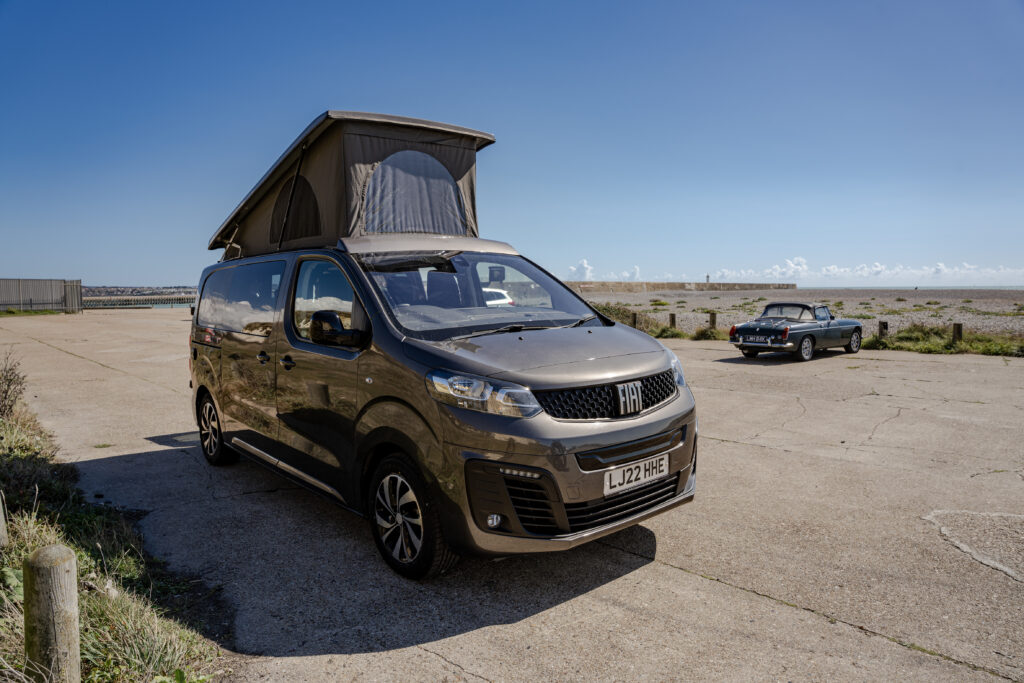
The e-Scudo flies under the radar. It’s sold under five badges: Fiat e-Scudo, Citroën ë-Dispatch, Peugeot e-Expert, Vauxhall Vivaro Electric, and Toyota Proace Electric. All are mechanically identical.
What makes it special:
- Full off-grid capability with gas heating
- Widest interior (1,628mm load width) for comfortable sleeping
- Genuine 4-berth with pop-top roof and rock ‘n’ roll bed
- Strong second-hand market with well-maintained ex-lease vehicles
- We can help source through our dealer partnerships, or you can find your own
Real-world range: 170–180 miles
Best for: Year-round camping, families needing 4 berths, people who want traditional campervan capability with electric propulsion.
View an example of E-Scudo conversion here.
VW ID Buzz
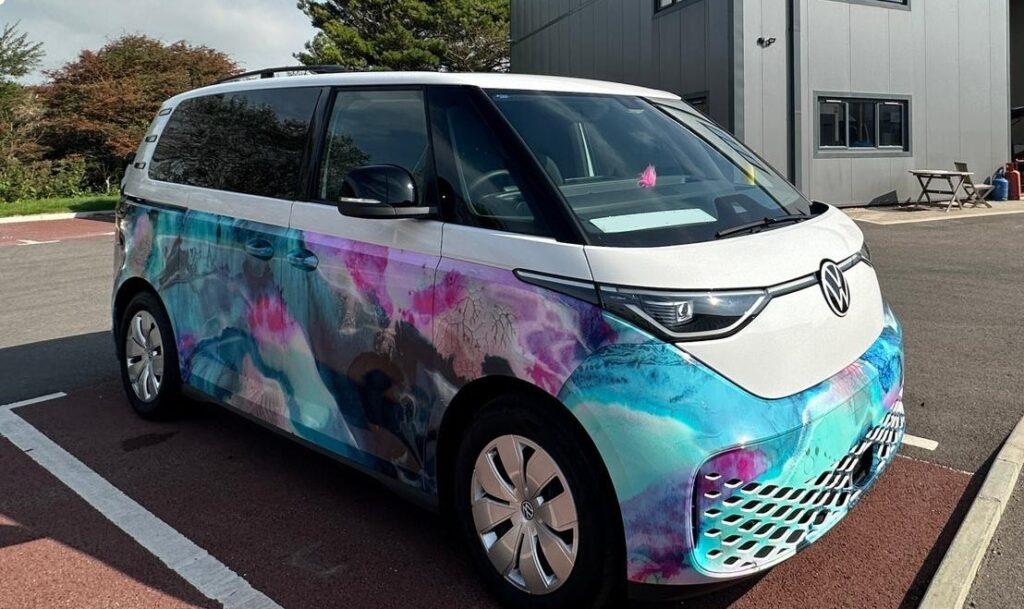
The ID Buzz is the icon. That T2-inspired styling, the modern technology, the driving experience. It creates an emotional response that specifications can’t capture.
What makes it special:
- Best range of the three options (180–230 miles real-world)
- Fastest charging (200kW capability)
- Styling that makes people smile
- Cutting-edge technology and driving dynamics
- VW campervan heritage reimagined
- We can help source through our VW dealer partnership, or you can find your own
The trade-off: No off-grid heating possible. You work with vehicle heating, hook-up, and 12V solutions.
Best for: Three-season camping, people who value styling and range, those happy planning around campsites in winter.
View ID Buzz conversions here.
VW e-Transporter / Ford E-Transit Custom
The familiar layout. If you’re coming from a T5 or T6, the e-Transporter puts an electric drivetrain into a format you already know.
What makes it special:
- Transporter name and layout, electric drivetrain
- Full off-grid capability with gas heating
- Reimo pop-top roof and Vario rock ‘n’ roll bed (German-engineered for this platform)
- Genuine 4-berth capability
- We can help source through our VW dealer partnership, or you can find your own
The consideration: Smallest battery (64kWh) gives the shortest range of the three. 150 to 170 miles real-world. For some use cases this is fine. For others it matters.
Best for: Transporter loyalists going electric, people who want the familiar layout with full traditional campervan capability.
View E-Transporter conversions here.
Making the Decision: Is Electric Right for You?
Electric Is Right for You If:
- You want a campervan that costs less to run and is better for the environment
- You enjoy the driving experience (electric is genuinely more pleasant to drive)
- You’re happy to stop for a coffee while the van charges on longer journeys
- You want proper off-grid capability (our conversions include solar charging for the leisure battery, and gas heating is available on the e-Scudo and e-Transporter)
That’s really it. Electric campervans work for touring holidays, wild camping, long road trips, weekend breaks. The technology has reached the point where the question isn’t “can I make electric work for my lifestyle” but “which electric van suits me best.”
Practical Steps for Making the Switch to an Electric Van
If you’ve decided electric is right for you, here’s the practical path forward.
Step 1: Decide on Your Priorities
Before choosing a specific vehicle, get clear on what matters most:
- Range priority? ID Buzz offers the most miles per charge
- Year-round off-grid capability? e-Scudo or e-Transporter with gas heating
- Maximum interior space? e-Scudo has the widest load area
- Iconic styling? ID Buzz
- Familiar Transporter layout? e-Transporter
- Budget-conscious entry? e-Scudo has the strongest second-hand market
Step 2: Think About Heating
This is the decision that shapes everything else:
- Gas heating (e-Scudo or e-Transporter): Reliable off-grid warmth, works like your diesel heater did, requires small gas bottle
- ID Buzz approach: Vehicle heating + hook-up + 12V blankets, different philosophy, works brilliantly for the right camping style
There’s no wrong answer. Just different approaches for different priorities.
Step 3: Consider Your Cooking Setup
Electric campervans offer several options:
- Induction hob with lithium battery and inverter: Fully electric cooking, higher upfront cost, dependent on leisure battery state
- Gas hob: Traditional reliability, works regardless of battery, requires gas bottle
- Hybrid approach: Gas hob as primary, portable induction for hook-up situations
The e-Scudo and e-Transporter support all options. The ID Buzz typically uses induction.
Step 4: Source Your Base Vehicle
You have two options here:
We can help source your van. We have partnerships with both Fiat and VW dealers, so we can help you find the right vehicle from trusted partners. We often have advance notice of suitable vans before they’re publicly listed.
Or source it yourself. Many customers find their own vehicle and bring it to us for conversion. If you go this route, here’s what to look for:
- e-Scudo family: 75kWh battery (not 50kWh), full service history, battery health above 90%
- Stellantis variants: ë-Dispatch, e-Expert, Vivaro Electric, Proace Electric are all mechanically identical to the e-Scudo
- ID Buzz: Growing used market with good availability
- e-Transporter: Newer to market, currently mostly new purchases
Either way, we’re happy to advise on what makes a good base vehicle.
Step 5: Plan Your Conversion
Every conversion is different because every owner uses their van differently. We’ll discuss:
Layout and Configuration
- Interior layout and bed configuration
- Storage priorities and how you’ll actually use the space
- Windows: we can add side windows and rear windows to panel vans, transforming the feel of the interior
Technical Specification
- Electrical system (standard 12V or enhanced off-grid with lithium battery, inverter, and solar panels)
- Heating approach
- Cooking setup (gas hob, induction, or hybrid)
- Solar panel installation for off-grid leisure battery charging
Making It Yours – This is where it stops feeling like a vehicle and starts feeling like your campervan. You choose:
- Flooring style and colour
- Upholstery fabrics (we offer a range including sustainable options like Chieftain Earthly, which is 100% recycled)
- Wood finish and colour for cabinetry
- Interior lining
- Curtain colour
What You Get in a Sunbox Conversion
We’re a design-led company, working at a small scale which means we are more atelier than factory. We build beautiful campervans using sustainable materials: FSC-certified wood, Thermafleece insulation (natural sheep’s wool for superior thermal and acoustic performance), and a range of quality fabrics including sustainable options like Chieftain Earthly (100% recycled) for customers who want them. Every van is handcrafted by skilled craftspeople.
Although we could choose to scale, we have decided to work at a relatively small scale, ensuring we can focus on the quality of each build, and offering variations of tried and tested designs. This lets us focus on getting each van right for the customer who’ll be living with it.
Ready to Explore the Transition?
If you’re seriously considering switching to an electric van, we’re happy to have a conversation about whether it makes sense for your specific situation.
Already know which vehicle interests you? Get in touch to discuss conversion options and timelines.
Still deciding? Book a consultation. It’s a 30-minute call where we discuss how you want to use the camper, which vehicle suits your needs, and what a conversion would involve. There is no hard sell and we are very happy for you to go away for another six months to think about it and do further research.
Want to see examples? Browse our completed conversions, vans we are working on for customers, or ask about viewing a finished van in person. This can be in person or via a video call.
Book a consultation via our phone appointment booking form.
Frequently Asked Questions
Can you wild camp in an electric campervan? Yes. Your leisure battery powers the habitation system (lights, fridge, water pump) just like in a diesel campervan, and solar panels keep it topped up. The e-Scudo and e-Transporter can have gas heating fitted for off-grid warmth. The main consideration is eventually needing to plug in to recharge the traction battery for driving.
- How much does it cost to charge an electric campervan? Roughly a third of what you’d pay for diesel to cover the same distance. Home charging costs around 5p per mile. Public rapid charging costs more, typically 8-12p per mile depending on the network. Compare that to diesel at around 15-18p per mile.
- Can you charge an electric campervan at a campsite? Yes. Most UK campsites with electric hook-up provide enough power to charge an electric vehicle overnight, though charging will be slower than a dedicated EV charger. You’ll typically gain 20-30 miles of range per hour of hook-up charging. This also charges your leisure battery and can power electric heating.
- Can you charge an electric campervan from solar panels? Solar panels charge your leisure battery, which powers the habitation system: lights, fridge, water pump, USB sockets, and (if you have the right setup) an induction hob. They don’t charge the vehicle’s traction battery. These are completely separate systems. To charge the traction battery, you need to plug into a charging point or campsite hook-up.
- How far can an electric campervan travel on one charge? Real-world range varies by vehicle: the ID Buzz manages 180-230 miles, the e-Scudo 170-180 miles, and the e-Transporter 150-170 miles. Cold weather, motorway driving, and a fully loaded van may reduce these figures a little bit. Most weekend camping trips (100-150 miles each way) are comfortable on a single charge.
- Is an electric campervan worth it? For most diesel campervan owners who do their research and choose the right vehicle, yes. Lower running costs, a better driving experience, and reduced environmental impact make the transition worthwhile. The key is matching the vehicle to your camping style: if you need year-round off-grid heating, choose the e-Scudo or e-Transporter. If you prioritise range and styling, the ID Buzz excels.
Related Reading: